Tampilkan postingan dengan label SVB on Wine. Tampilkan semua postingan

Bra-Burning Feminists Drive Wine Sales

The business world moves in cycles, and if you live long enough you start to see them repeat. Today the popular press is replete with articles hyping the Urban Millennial Myth.

Its the older tradition-loving Boomers who have become accustomed to Madison Avenue solving every need, want and desire - versus the edgy up-and-coming Next Generation. The Next-Gen is nothing like you've seen before and you need to get current with your marketing or you will end up on the losing end of the stick.... or so many would have you believe ... except its really a repeat of a cycle we've seen before and we can see the outcome.

Cycles & Susan B. Anthony


Boomers today drive wine sales and its the women Boomers who are the primary wine buyers according to many studies. Those were the the same bra-burning feminists that were labeled as radicals back in the 1960's and early 1970's when they were Millennials. They were nothing like we've ever seen before either .... well .... there was Susan B. Anthony in a prior cycle but that's another story.

If you decided to craft a label to attract Millennials today, what would that look like? The press tells us Millennials are adventuresome, irreverent and demand transparency, sustainability and authenticity. What about their desired product attributes in a wine purchase? What do they want?

An article that came out last week says Millennials are looking for non-pretentious products, non-traditional packaging, simple wines at an affordable price that speak to them; each are reported solutions for cracking the Millennial Code and developing a successful wine marketing program to that untapped pot of gold at the end of the cohort marketing rainbow.

Rima Fakih (Photo courtesy of Miss Michigan USA)
A restaurateur who targets Millennials, answers the question within the article noted above by talking about how he decided to create wine lists that ...
"...flout the bureaucratic rules that dictate how wine should be made. It’s an eclectic, slightly subversive list with a decidedly anti-authoritarian bent."
The description of Millennials and what they like sound eerily familiar ... non-traditional packaging, simple wines at an affordable price.... transparency, authenticity, adventure, irreverent behavior.....


Boom-illenials
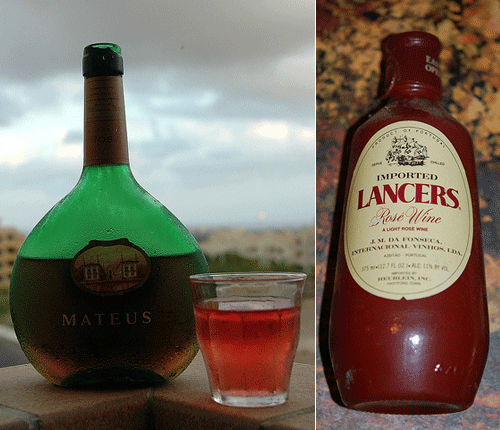

Back to cycles - there was a day when the Boomers weren't traditionalists either. In the 1960's we Boomers wanted transparency... except we called it Government lies. We wanted authenticity ... except we called it "getting real." We leaned toward being irreverent, and were called radicals. We were part of the Occupy Movement  ... except we called the event a "sit-in." And we also drank wine - mostly inexpensive sweet wines; Blue Nun, Reunite (on ice ...), Grey Riesling, Mateus, Lancers, Rhineskeller, Paul Mason wine in carafe's, etc.

Those brands were the wine companies solutions for marketing to the Boomers in that era .... wines from non-traditional regions and presented in non-traditional packages, emphasizing fun, adventure, and sex appeal. We were really anti-authoritarian, sustainably-green. Heck, we even recycled the Lancers bottles as candle holders! Millennial current day likes and dislikes are very similar to what came before them so there is a road map and we are seeing the same thing happening with the growth in Rieslings as an example, and the multitude of packaging.

Radical Feminism and Wine

 
Maybe Susan B Anthony didn't let liquor touch her lips, but Boomer women have been found in several studies to let a lot of wine touch their lips, and and one can argue women Boomers are the most important wine cohort today. In one study, The Wine Market Council recently estimated 53% of people who drink wine more than once a week are women. Maybe someone should have marketed to them back in the 60's? Radical feminists as they were called in the 1960's, brought attention to their second-class plight by casting their makeup, high heels, girdles and bras into trash cans labeled "Freedom Trash Can" at the 1968 Miss America Pageant.  In a decidedly anti-authoritarian manner, everything was tossed into the can and it was set afire.  
Gloria Steinem is one of the best known feminists. She was at the epicenter of women who were burning their bras at the Miss America Pageant and working for positive change for women in our culture. Where did she end up? She's spent her life trying to advance the cause of women, but she's mellowed and become less radical and more traditional  today. When she was recently asked to opine on Miley Cyrus vulgar dance (!generation gap alert!) at the VMA awards, this was her response:  
Gloria Steinem
".... given the game as it exists, women make decisions. For instance, the Miss America contest is in all of its states ... the single greatest source of scholarship money for women in the United States. If a contest based only on appearance was the single greatest source of scholarship money for men, we would be saying, "This is why China wins." You know? It’s ridiculous. But that’s the way the culture is. I think that we need to change the culture, not blame the people that are playing the only game that exists." (highlighted for emphasis)
Wow! That's a huge evolution for Gloria Steinem. Not only did she not condemn the Miss America Pageant, she applauded the contestants for doing what they could do. Apparently, even the most radical among us will evolve over time.  

Should I Market To Millennials Now?

Looking at how Gloria Steinem has evolved, do you think a brand created for her in the 1960's would still be effective today? I've heard the argument from many that its important to market wine to Millennials now, so they will be the next generation of wine drinkers. If you make $10-$20 wines as a mainstay, then by all means - market to Millennials because they might buy your wine today. But if you are making wines that are $20+ wines, then you are wasting your scarce marketing dollars.
All that said, if we want to have Millennials learn to love American wines when they are in their thirties, that is an American Wine Industry issue. No question in my mind that the younger generation has access to and is drinking better foreign wine than the Boomers at a similar point in life. That should be a concern to the US wine industry and we should be looking at putting a Wine Marketing Order in place.
Take a clue from history. Were you to make a wine that appealed to the 60's Bra-Burning Radical Boomer Feminists when they were in their early 20's .... brands like Blue Nun, Grey Riesling, Mateus, Lancers, Rhineskeller, Reunite, Paul Mason wine in carafe's, etc. .... your branding would have been wasted just like those brands have wasted away to being gone or almost gone. The women who consumed those wines back then today really don't drink those wines.  In the same way, there is little chance that the Millennial will develop loyalty to your brand that hits all their wants and desires now, and who stays with your brand forever because you were first to their party. Why? Because their tastes will change and when they have the money to make impactful purchases of your $20+ wine, they will be off to something else. History will repeat itself.
 

Millennials Are Last in Wine Spending

 
In the article I mentioned above, we sadly find the seemingly requisite and misleading stats that overstate the Millennials importance in current wine consumption, contributing to the growing urban myth by saying,   
"...about 39 million U.S. adults drink wine several times a week. Millennials make up 29 percent of that group, while 39 percent are baby boomers." A quick read of that might lead one to believe Millennials are #2 in spending and right on the heels of Boomers. But if any cohort is on the heels of Boomers, its the ignored Gen X cohort, and it really doesn't matter which price point we're discussing as you can see in the chart above. Millennials are last in terms of spending on wine. I discussed the Millennial myth in greater detail a couple weeks back in the post Millennials Aren't All That.       

Urban Myths and Women

I challenge anyone to find a reliable statistic that shows Millennials are spending more on wine than Boomers or Gen X'ers today. If you believe that to be true, then you've been sucked in by the Urban Myth of Millennials..... just like the myth of women burning their bra's in the 1968 Miss America Pageant. True story .... that never happened either. Nobody burned their bras at the Pageant and it was rare that anyone ever did. Its just another urban myth that keeps getting repeated over and over again until it starts being true, exactly like the Millennial Myth that is advanced into urban legend by self serving reports and reporters. The reality is that what you read in the press (and stupid blogs for that matter) ... what's written isn't always true. Deciphering the truth can at times be perplexing, but from every angle available - what is clear to me is Millennials will evolve just like the Boomer women evolved, moving from gimmick wines and unique packaging, to more structured wines, and then to fine wine. Of course that's a generalization and you can just as easily argue not all will evolve that way and I would agree. For now though, Millennials shouldn't be the targets of most family winery marketing programs today. Gen X should be your growth engine and Boomers should be your "cash cow."
The Feminism Movement made enormous strides for women's rights but with wine, there is more work to be done. In an article three years ago, a Master Sommelier pointed out 80% of the time a male/female couple sits at a table together, its still the man who is given the wine list and expected to make the decision. I'm thinking women deserve an equal chance to grab the list and suggest the practice of putting the list in the middle of the table makes the most sense.
And finally to Gloria Steinem, turns out she is a Boomer and a wine lover - go figure. If you are interested, and are planning on being in New York on December 23rd, you can see her at the City Winery with the musical group BETTY and ask her what she thinks.  

What are your thoughts? Please log-in and offer your comments for the community and if you think the read is worth passing along on your favorite social media platform, I'd appreciate it!

Experiment or Die


Stupid mistakes and do-overs. Come on. Admit it. You've made your share. I made a similar mistake to the lumberjack in the above video. Trying to save a couple hundred bucks by not hiring a professional, I cut a tree limb away from my sliding glass door. Cutting straight down with a chain saw the limb cracked and held together by the fibrous bark. Like a hinge it pivoted down, perfectly connecting with the glass door below shattering it to pieces. It cost me $1,200 to replace the door and I've never made the same mistake since.

How does your organization treat failure? Are mistakes something that end up in performance reviews, or brought up later in a conversation when a point is being made? Failure is a component of learning and innovation. Do you have a philosophy surrounding failure in your business culture? Are there written values that talk about the process of innovation?

We have a lot of experienced people at Silicon Valley Bank and a long culture of innovation. Those people have had the most opportunity to make mistakes so you can argue are the biggest failures. After 30 years since our founding, the bank has been trying various things to celebrate the milestone. One thing we're doing is offering 30 weekly pearls of wisdom from people who've been here the longest. This week marked my 24th year at the organization and coincidentally my quote was the one shared this week.

The World According to Rob

The way I see the world, there are tactical failures and strategic failures. On the strategic side of things you have to be able to try old things in new ways, or discover brand new solutions. Why? Because the world and business is evolving every day. In fact I think the wine business is operating under something of a Moores Law and the pace of change is redoubling at an exponential rate. Are you keeping pace?

Weapons of Mass Culture Destruction

So many business cultures are full of doubt. "What? That's a crazy idea. That will never work..." Ever hear that one? I can't tell you how many times someone, in response to a new idea asks me: "Who has ever done that before?" as if we have to have someone else as a template before trying something new. If that is your culture, you will never be an industry leader. You will never be first to market and have a first-mover advantage. Sure there is a risk in failing, but if you judge people by their failures, then they are failures. Judge instead by their successes. If you really want to judge by failures and you are a hiring manager, then you better look in the mirror because you hired them making you the real failure. Apparently you would rather hire lemmings who don't take risk versus hiring people who are willing to try and fail.  

If you aren't allowing people to experiment and fail to evolve the business, you will die because your competitors will blaze by you. You might also look at management because there is potentially an issue of managers asserting control instead of allowing employees to use their God-given talents to succeed in the manner in which they will be the most successful.

But they are always making mistakes!!


Sometimes the best answer is the simple one
It's not the volume of mistakes made. Its learning and improving from the mistakes that really is important. If someone can't learn, then maybe they aren't in the right job. But if you hide daily mistakes, I guarantee the mistakes will continue, particularly in tactics and daily execution.

I worked in an organization years ago that had a fear of failure. In fact I remember being told by a senior person, "The first rule of banking is: Blame someone else." Making mistakes in that culture was a certain way to have a short career. Guess what? Few people have long careers there unless they get really good at deflecting blame and playing politics. The culture sucks. What happens in that environment? Mistakes get buried. You never can help people grow because all mistakes are magnified, they show up on your performance evaluation, and client care suffers because you can't address hidden issues. Failure happens still. It just goes underground and everyone walks around talking about what an awesome job they are doing because its a mistake-free environment.


Celebrate Failure !!

My view is you have to develop a culture that celebrates failure because failure is a key component to success. You have to have values embedded in the business culture that reward and encourage those who try and fail. Failure is a form of tuition. You paid the tuition so you might as well harvest the learning and evolve. If you lack business values that protect this critical success element, your company is already dying. 

Here are some other thoughts to consider in your winery business culture:
  • Does your culture have the puritan ethic to punish failures?
  • Do old mistakes get brought up in passive-aggressive ways? "Oh boy. That sure didn't work out .... haha."
  • Are those who naturally have ideas given a platform for you to harvest their thoughts?
  • Do those who question process get an open opportunity to voice their solutions without fearing political backlash from others supporting or running a business process?
  • Do your managers use ideas that come from others and then give credit where credit is due? or ... Do they take the credit themselves for ideas?
  • Do managers ignore other's ideas and only implement their own to elevate themselves?
  • How do you know you have a culture that has a wide funnel to hear new ideas? Are you only talking to managers?
  • Do you have a stated business perspective regarding innovation and failure, or is it left unsaid because "everyone gets it?"
  • Are successful ideas given lavish attention? Or are successes no different that any other positive thing in business?
  • Are failures talked about openly so everyone can learn? Or are the feelings of the people considered first? In an environment that truly celebrates failure, open discussion of failure is no big deal.

What do you think? Any examples of successes or failures from your past? Any thoughts about the way successful and unsuccessful companies create a culture surrounding innovation and failure? Is there anything here that stimulates your thinking and resolve to effect change?


Please log in and share your thoughts with the community, and by all means - share the discussion in your favorite social media platform.


Grape Prices are Heading Lower.

Total Wine Sales Continue to Move Higher
About six weeks ago I was asked to speak about the economy, the environment for the US wine consumer, and the fine wine business. The meeting was part of a management retreat for a large wine company and included an acquaintance of mine who we will call "Deep Gullet." It included many of the distributor partners of the company as well so there was quite a wide perspective on the business. This wasn't a client of mine and never will be, but I took the invitation because I thought I might learn something from Deep Gullet and the other presenters. I did and came away with two important perspectives:

  1. The small 2011 vintage was really difficult for fine wine distributors. Allocations were more the norm for their retail accounts because there just wasn't enough wine produced.
  2. Attempting to increase bottle pricing - even in an allocated environment has been like pushing a wet string up the hill.
Overwhelmingly everyone believed 2012 was going to be a lot better from a supply perspective given the large and record harvest, so the allocation issue was probably temporary. The second issue however was about the consumer and that didn't seem to be going away. That got me wondering again about the popular press reports on supply shortages.

In the 2013 Annual State of the Wine Industry Report released in January of this year, I predicted that we were going to see a soft first half of the year economically, but an improved second half. You can read the report if you want to check my thinking. We predicted a 4th consecutive year of lower sales growth in fine wine; something between 4%-8%. It's still growth but growth has been slowing for some time. 

At this stage, we appear to be tracking well to the overall growth estimate but will have to wait to see sales results for Oct-Dec to see if we were correct in our annual prediction. After exchanging some G2 with Deep Gullet we discovered we were of the same belief: What is clear at this point is while wine consumption continues to increase in volume as seen in the lead chart, GDP is stalling and the middle class aren't able to fully participate. Yes .... Americans like wine and are drinking more in volume, but they aren't paying more in price to support winery production cost increases. The following chart is really descriptive of that point.
 
Source: Nielsen Beverage Group
My friend Danny Brager from Nielsen presented the chart to the right recently at a conference in which he was speaking. While all F&B categories are up 1.7% in price on average, wine is only up 0.20%. Consumers aren't accepting price increases for wine or spirits for that matter. The economy isn't supporting price growth and inflation seems to be well in check. I'll spare you the in-depth analysis of what's happening in the country that's holding back economic growth but here are some high-level bullets:
  1. Housing has indeed recovered most of its value now which is a huge help to the middle class... should lead to a bit of a wealth effect and release pent up demand in sectors, and allow more movement between jobs in different regions. That should have helped support a better second half of the year as I'd thought, but now I have my doubts because of higher interest rates and Sequestration 2.
  2. Youth unemployment rates are still very high in the main industrial countries of the world (Yes Virginia, the Millennials aren't reading the press about how they are driving growth in wine sales. They are a big cohort but have no income.)
  3. Boomers are hitting retirement age. They drove the growth in wine since the middle 90's so that is a big accelerating headwind in the face of fine wine purchasing.
  4. The wealth gap is widening. The wealthiest Americans have recovered their pre-crash wealth and are spending. The middle class while improving off the bottom, need real work to spend and while the unemployment rate continues to decline, the US labor force is shrinking. There are fewer people working than before even if the unemployment rate is falling.
  5. The Fed announced last week they were postponing tapering. While the markets loved it, the reality is we are careening to another 'fiscal cliff' on funding and proving the S&P upgrade of the US credit rating earlier in the year might have been premature. What the announcement means is the economy isn't doing as well as the Fed would like and they are going to keep throwing economic crack at the market until they are a little more certain there is a recovery. In the meantime however, the long bond in the US has gone up dramatically since May and that means the middle class is less able to afford the houses to which they were aspiring. We see that in the sharp decline in new mortgages application rates.


Now move to grape and wine prices over the past 2 years. With most predicting a grape shortage by April/May of 2012, growers began to recover pricing that had been depressed since the recession started. Then we had the 4MM ton harvest of 2012 and the shortage - to the extent there was one, went away. Since non-bearing acres are so low and planting stagnated in the last decade - not even keeping up with vine replacement, most wineries looked through the heavy 2102 crop and still were willing to pay higher prices this year. With the the 2013 harvest now well under way, tanks are full and there is still a lot of bulk wine for sale. It looks like the harvest is coming in large once again. 


Prices Have been Dropping as Volume of Bulk Increased
So where does that leave us with grape prices? Add it up:

  • Current 2012 Bulk Prices are flat to trending down
  • The economy is not seeing the growth I'd hoped for in the back half of the year.
  • Consumers haven't been willing to pay more for wine and based on the recovery sluggishness, I can't see them willing to pay more going into the holidays or even 2014 at this point.
  • Producers have been paying more for grapes and getting their margins squeezed because the costs can't be passed on. 
  • Supply isn't short for wine right now, and it looks like we'll have two back to back large harvests.
That leaves me and Deep Gullet to believe we won't see new grape contract price increases in 2014. Taking all the factors that impact price into consideration, the only question at this point is longer term supply. Are there enough acres planted? Should grape buyers look through the the large 2013 harvest again and view 2014 as likely short? If some of the higher tonnage of the past 2 years is a result of changed farming practices - and there is that possibility - we may not be as short, even in the long term as many have predicted. In the meanwhile while we ponder the balance of grape supply and demand, there are plantings taking place.

My conclusion is all things held equal, at the end of the 2013 harvest we should see downward pressure on grape pricing.

What do you think? Please share this piece in your favorite social media app, and log in to share your views with the community. The wine world wants to know what you think!

What's the Surest Way To Fail in Business?


This is my 50th post and I'm celebrating by taking a vacation and  am writing this morning from my hotel balcony on Waikiki. That was an unabashed I'm-having-more-fun-than-you comment..... and I'm clearly warped to be writing on vacation.... Anyway...

Going through graduate school I took a class in Organization Behavior. I liked the class because it was high-level and covered a number of important theories, and yet - the title of the course always bothered me. It seems like such a non sequitur. It's as if an organization has feelings or predictive behavior, and of course it doesn't. Organizations and wine producers for that matter are made of people with feelings, perspectives, insecurities, and values. While marketing, sales, production, viticulture, and administration are all important parts of running any wine company, in the end without an established business culture used as a touchstone for behavior and decision-making, the other disciplines will struggle or even fail no matter how awesome the product or strategy. Leaving a company's values unclear or believing everyone just knows what you stand for without talking about it is the surest way to fail.

The Question of Cultures


I was reminded of this on a trip to Hawaii yesterday. We got on a plane out of Oakland for a 5 hour trip to Honolulu Hawaii in coach. Its always a long flight but I try and sleep so I get there quicker. That's a trick I learned as a kid when we drove to Disneyland from Concord. CA. Sleeping wasn't an option this time because there were a group of six Persians in front of us with a beautiful young 5 year old boy. It was a party from the moment we took off. There was laughing, jumping and dancing in the isles, the beautiful child yelling at the top of his lungs participating in his family dynamics. They were going to Hawaii and they were HAPPY and didn't seem to mind if others around them wanted to sleep. The young boy was doing nothing more than participating in his family culture. He was emulating his family.


Then next to me there was a 25 year old graduate of San Jose State from Mumbai. She was second generation and it was her first trip to Hawaii and her longest plane flight ever... really nice girl. Her family of 8 people were all going out on a Norwegian cruise around the Islands. They too were happy and the parents were talking loudly behind us and unconsciously kicking our seats through the trip for some reason. The older folks got together in the isles and were laughing and dancing.... they seemed focused on themselves and didn't seem to mind if others around them were trying to sleep. When the plane stopped, they started to push their way through the isles past people trying to get up. I don't know if it was an cultural behavior or not, but they missed the rule most of us learned in Plane Flight 101 that you wait until the people in front of you get out of their seats before you do.


Some people would take that description as a flight from hell. While it sure wasn't the best, you deal with what is on your plate. You get what you get and you don't pitch a fit. For all I know, to others around me I might be thought of as rude for trying to sleep? Maybe I should have joined in their dance and forgot about sleep. Instead I turned to the drug of choice on flights to Hawaii: Mai Tai's. Everything seemed to be better and in my slightly inebriated state got me thinking about corporate cultures and values.

In this case, we had distinctive and separate cultures on our part of the plane all operating independently. Thank god we didn't have to operate in some sort of a team to get to some common goal, because there was a lack of commonality. How would we make decisions .... even the simplest like should we use the First Class bathroom if the other ones are full?

Organizational Behavior and Hospitality


How does that relate to wineries? We have become an international business. People come from far and near with wide ranging cultural norms and biases. We are their hosts and have to be ready to help them have a memorable time. Its our opportunity to help them leave with a brand positive perspective on your winery, and our Country. You can't judge their behavior by our standards but should be encouraged to understand the cultures of your guests and be long-suffering if needed.

Second and more important, the USA is an immigrant country and is made of diverse families with different norms and beliefs. To be successful in business, we have to establish our own work culture that emphasizes hospitality as a base value.

Some of My Culture Beliefs and Examples


At Silicon Valley Bank I'm very proud of our culture. Its one where everyone tries to do the right thing. Profitability is important, but not as much as our values. Profitability I argue follows BECAUSE of our values. Everyone's viewpoint is appreciated and we've developed accepted ways to behave and make decisions. Debate-decide-deliver. We talk about "the shadow of the leader;" a concept that means leaders of organizations can't take a "do what I say, and not what I do" model or take credit for the success of others in our team. We believe in recognizing others success and that we are not in competition internally. Its not a net-sum-zero game. There is much more to our Bank's culture and we are constantly talking about it and reviewing the fit.

On my specific lending team of 5 people, we have several rules that we adhere to that make behavior more palatable. I believe feedback is an everyday thing and that's what we do: give feedback on the fly when there is teachable moment. We believe that mistakes are tuition and that pretending mistakes don't happen stops continuous improvement on the team and waste that tuition. We are fine with making mistakes. They happen and don't show up in reviews in any material way because they were already covered. Reviews in fact are kept as low-key as possible because they are an administrative thing, not a tool for improvement. They are never motivating (Don't tell HR I said that please).

We believe that we need to be direct and respectful in the way we communicate with each other. That means we hold each other accountable for our failings and speak our mind instead of supporting some circular gossiping sophomoric culture. We support each other in what we do, and support our clients efforts. There is always someone on staff for our clients to reach. I believe I am responsible to my staff and each year ask in a safe manner, what things I need to do to improve and what they like. We believe we are in the hospitality business and our clients and their employees are our guests when they come to our offices.

All of those rules establish a culture within the Bank that is good for decision-making, respects individual beliefs and values, insists on team play, rewards success, inspires evolution and new approaches of doing things, and makes for one great place to work. Given time, the plane of people on my trip to Hawaii could come together develop mutual respect and trust if we started first with addressing The Surest Way to Fail in Business and developed shared values. Our Bank and team are great places to work.

What about you? What are the rules that your company lives by? What are the values that are not negotiable? How are you reinforcing your culture? How do you measure your culture and success in achieving change? What thoughts and experiences can you share with the community about your learnings in building healthy and successful cultures in business.


Please log in and participate in the discussion. Oh ...... by the way, as you can see in the first picture, I made it to Hawaii! Aloha!

Are You Adjusting Your Marketing To Boomers?

Never Bet Against A Dog That Tells You They Can't Play Pool 
 
"If you aren't starting to make some adjustments in your current marketing strategy to Boomers, you will lose your most important current wine buyers sooner than you think, and another winery will pick that consumer up who will adapt to their changing preferences."


My mother plays pool, has an occasional nip, likes pink and is a dog. She's actually a wonderful person, but I've been trying to break her from nipping for years. Now it seems the years themselves are actually slowing down her nipping, which isn't good for the wine industry when considering her in terms of her Mature Cohort. A non-nipper wouldn't be the person a winery should try and attract. (Don't play pool with her either.) 

My mom can nurse a large bottle of moscato for a month. Obviously if she is representative of her generation, when it comes to developing a strategy to attack the geriatric set there are probably better places to invest your precious resources. But if you listen to many in the wine press, they will say its the Millennials. I believe if you sell fine wine and that's what you are going to do, I suggest you would be better off investing in my mom's cohort today because they can at least afford your wine, if you can convince them to buy it.

Millennial Myths


We've been writing for years on the Millennial Myths, the most prevalent one being Millennials are driving fine wine sales. That's absolutely false. They aren't driving sales and there shouldn't even be a debate. I found -this article- from 2009 which is a good example of the kind of confusion that's been layered onto the discussion. Take for instance this quote:
"the U.S. ranks third in total wine consumption, and is gaining rapidly on the leaders. Much of the (3.3% ~ 850,000 case) increase can be attributed to the Millennial generation"
Market Share of Wine Sales Sorted by Cohort
It wasn't true in 2009 and isn't true today. What is true is the Millennials have the highest growth rate, but like all segments with low numbers of consumers, the high growth is because of the small base versus the growth in the nominal consumption of the segment. 

The chart directly above is one I used for a speech in Sonoma in May. It's from a survey we do of West Coast Wineries and shows that Millennials represent less than 15% of total wine sales. That's pretty consistent with Nielsen information as well.

Don't Market to People Who Can't Afford Your Product


The way I make practical sense out of the avalanche of miss-communication and demographic-goguery, is to break it down into component parts. Buyers of anything have to have the willingness and the capacity to buy. For example, my 20 year old Millennial daughter wants a new Range Rover - she has the willingness. But as a sophomore away at college, she doesn't have the capacity in her budget. I've heard some people argue that you need to market your wine to the Millennials now because they are the future. In the same breath, I've seen market research on Millennials where they feel they aren't being catered to because they want less expensive and better wines. The truth is DOMESTIC wine should be marketed to Millennials as a category, but its the lower priced wines that attract those consumers today. For now though, lets just stipulate to the belief the Millennials have a greater willingness to drink wine than any previous generation ( .... its not a proven fact either because the data aren't available from previous generations, but lets just go with it.) Do Millennials have the capacity or disposable income to buy fine wine?

I looked to the most recent information provided by the U.S. Census Bureau on both wealth and income levels. The data reveal that the older boomers have the most wealth followed closely by the Matures, with Millennials having amassed only about 2 percent of the Boomer wealth still early in their careers. 

I also reviewed the top 20 percent of all wage earners sorted by age. Again its the Boomers leading the pack as the highest paid, followed by the Gen-Xers, the still working Greatest Generation, and last again are the Millennials. So if it was only the capacity to buy, that information might suggest a winery should have a plan to go after the geriatric set since they have the capacity. The problem is, the older generation doesn't have the willingness - or maybe the kidneys to be a dominant cohort in wine sales. Back to the question, where do you invest your precious marketing budget?


Boston Consulting Group Matrix


The answer isn't binary. Your marketing budget needs to be spread out a bit but focused largely between high growth segments, and those segments where you have a high market share. 

The basics of the now legendary Boston Consulting Group's Growth Share Matrix is pictured to the left.  My mother the dog as the chart shows, falls into a segment in the lower right quadrant that has a low market share and low growth rate. In the BCG Model, she is termed a dog and that is the cohort you want to put little if any of your marketing resources. The above chart on Market Share shows the Mature Cohort has a 14% share of fine wine sales now. That's about the same as the Millennials, but you should be investing more in the Millennial Generation versus the Matures because Millennials do have growth upside while Matures will be turning up daisies making them ineligible for wine purchases relative to Millennials. Plainly, there is no growth opportunity with my mom's generation.

Between the remaining cohorts - the Boomers and Gen X, where should you invest more of your attention and marketing dollars today? The Boomers are far larger than Gen X and they have more capacity to buy, but you really should be investing a fair amount of your time and effort now attracting new Gen X consumers instead of new Boomers. Gen X are - or should be, the current stars of the portfolio looking at the matrix. They are the consumers that are going to drive your sales growth higher as the Boomers kidneys hit retirement age.


It's True: My Mom Gave Birth to a Cow


To keep it fair, while my mom might be a dog, as a median aged Boomer, I am a cow; a "cash cow" to utilize the BCG model. I may not be able to beat my "Dog" mother in a game of pool, but I can swim better than her. I just need a little help lifting all that dead weight out of the pool these days. 

Anyways ...fine wine producers have to be relevant to Boomers because they have the highest market share in wine purchases still, and they will for some time yet. You need to "milk" the Boomers by spending less vigerously versus Gen X. You need to utilize this cohort to fund investments in product development and marketing to other growth cohorts. But if there is something you can do with the Boomers today in terms of investment, its looking for product changes that might elongate the length of time they remain your wine buyer. That is a very important consideration and worth contemplation and further investment. That will return a solid current ROI.


Why Will Boomers (and Matures) Slow in Wine Spending?


You may think that you are doing the right things to market to Boomers today - just like you always have, but that's no guarantee of their future behavior relative to your wine and purchase preferences. The Boomers are evolving and without adaptation of your brand strategy, you might find them growing away from you before the Millennials come to rescue your sales growth. I wouldn't expect the Matures to adopt Millennial behaviors that would keep them as a viable sales cohort .... generally speaking that is, but even they might benefit from answering the following question - Why will people slow their spending after age 60? Answer that and you will find a correct path to market to Boomers and even Matures as they age in the next 10-20 years. 

While part of the reason they spend less is retirement, the reason they will decline in market share is really because they can't continue to drink like they did when they were Millennials (sic). So the simple solution is, consider making some wines that are lower in alcohol but maintain the other attributes the older set prefers. That's easier said than done in the warmer AVA's, but there are available technologies to make a wine that has a traditional flavor profile and has less alcohol, and might fit their pocket book as well.

To that end, last week I came across an article advertising some new marketing research about the size of the Low Alcohol category. link. One statement in particular stood out to me:
"Once considered a niche outsider product category, lower alcohol wines are now growing in stature in many markets around the world. Across the 8 markets looked at in this report, buyers of sub 10.5% ABV wines now account for 38% of consumers, or in other terms, over 80 million regular wine drinkers -making a rather compelling case that this is a market sector which can no longer be ignored. From the 8 markets analysed in this report lower alcohol wines are currently performing best in the USA, Germany, Canada and UK where the number of lower alcohol buyers and consumption of sub 10.5% ABV wine is the highest."

I think that's where we should leave it for today. Hopefully that gives you some food for thought.

What do you think? Should you be spending all of your time marketing to Millennials? Are you investing in the best growth opportunity for today (Gen X)? Are you seeing declines in purchasing from Boomers and falsely attributing that to lower income from the recession? Are the Matures worth marketing to still? Where should you invest your precious marketing dollars and time selling your wine?


Please log in and offer your thoughts to the community.

Wine Sales In the Last Half of 2013

The Best View of the Housing Bubble Pre-Crash
I recall giving a speech in August of 2008 to about 125 growers and winery owners. The speech was on the economy and I pulled up the slide above to demonstrate what I was seeing ahead of us. This was at a time just after Lehman Brothers collapsed where it had become apparent that we had crested a market high in housing and entering a bearish period. What the chart says in brief, is the historical average ratio of existing home price divided by median 4 family income is 2.8 times. That's what the red line is. With a ratio of 2.8 times, if a family made $100,000 a year, they could afford a $280,000 home. You can see what happened by late 2006 into 2007.


We are taught in school that in economics, measures have a tendency to revert to the mean. But talking heads everywhere were suggesting back then that what we were experiencing was a normal correction. Maybe, but the chart above along with some other indicators told me otherwise and I suggested we were about ready for a nasty correction and reversion back to the mean, and that correction was going to be huge and take years based on the slope of that line. 

If that weren't enough, I also suggested the growth rate in wine would fall to flat (zero percent) growth. I really thought there was a strong chance wine sales growth could go into negative territory for the first time in memory - but predicting that would get me permanently banned from the Economic Optimists Union so I fudged up a little on the forecast. I was actually being optimistic on what was ahead for us, but people didn't hear it that way. My speaking invites started falling like the stock market. I've never been invited back to speak in front of that Grower Association again. From all sides the message was, "If you don't have good news to report, then we'll find someone who can." Well, OK then, go ahead and listen to your excessively optimistic speakers and see if I care. My dog still likes me and my mom still ...... well ...... my dog still likes me anyway.
 

"The housing correction poses the biggest risk to our economy. Our economy and our markets will not recover until the bulk of this housing correction is behind us." Treasury Secretary Henry Paulson, 11/12/2008

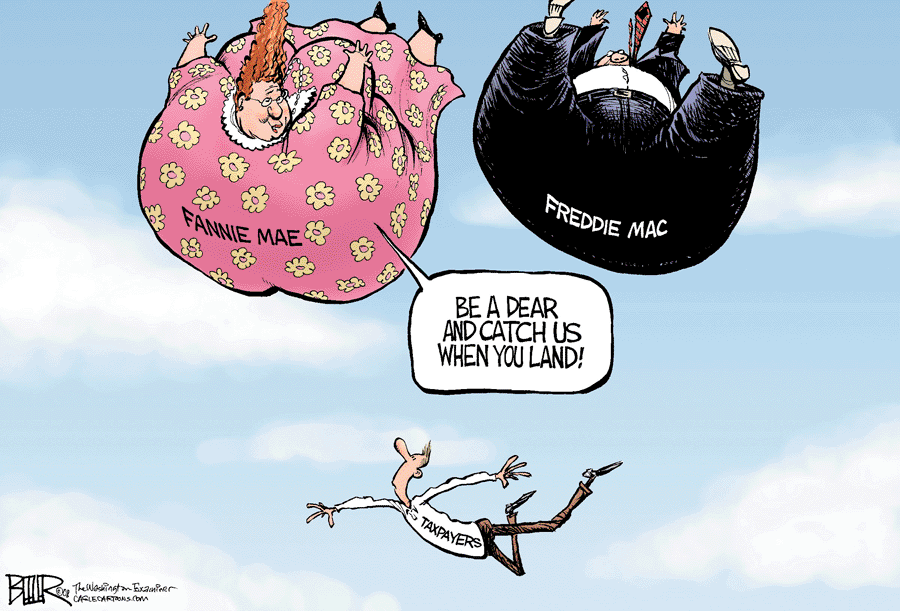
This video was what we saw just months after the speech I made noted above. It was pretty stinking gloomy. The stock market was in the crapper and home prices crashed. With speed never before seen and perhaps treading on Constitutional Authority, the Government and Secretary of the Treasury Hank Paulson started to make investments in the Banks through the TARP program and several other initiatives. Ben Bernanke started to throw money at the financial system and economy. The banking system and Detroit were stabilized. But with the markets dragging bottom and hundreds of billions of dollars being thrown at US industry, the average voter started asking the question, "When do we get a bail out?" The answer came soon enough though most of America missed the memo when Fannie and Freddie were put into conservatorship to protect the US mortgage market from vanishing, causing a free-fall in house prices.

So where are we today? Fannie is actually starting to repay the bailout money (Self serving note: the Bank bailout through TARP was paid back with a sizable profit to tax-payers thanks to the strings Paulson put on that Bailout.) Of course Detroit is now going Bankrupt, but the American Auto Industry was able to rationalize their insane Union compensation plans, and has a chance to pay back a large part of that bailout, if not all of it .... well most of it anyway. The economy isn't healed but the most recent Case-Shiller Index had this happy news last week:
"As of May 2013, average home prices across the United States are back to their spring 2004 levels. Measured from their June/July 2006 peaks, the peak-to-current decline is approximately 24 to 25 percent. The recovery from the March 2012 lows is 16.5 percent for the 20-city index."
Essentially the news is, housing prices are back! In the Bay Area consumers even see an overheated market again with multiple offers and short listing periods. So I was wondering now ...... just where is the recovery in terms of the measures in the chart at the top of this page? My speech back then said that we had to revert to the mean. Paulson said we wouldn't see the economy and markets recover until we had the bulk of the housing correction behind us. Did we get there? The current information out there suggests we have reverted to the mean and are now showing home values at 2.85 times median income. Of course the bad news in that is we will likely see growth in home prices slow now due to investors cashing out and more of the average mortgage payment going to interest, thus reducing the amount of house a person can afford. Being an optimist, we are at least not looking at another bubble. Housing growth will take place as median incomes rise.

Consumer Comfort Index at 5 year high
Don't get me wrong. There is a lot to do still to heal housing and the mortgage business. Banks aren't able to make home loans anymore and sell them as packaged securities. Prior to the crash, that was half of all new bank lending. Now it's 0%. Banks now have to keep the loans on their books or sell them to Fannie or Freddie for the present. While its nice to know they are starting to turn the corner, last week President Obama outlined plans for the wind-down of the Governments involvement in those institutions. Having just gone through qualifying for a home loan, I can tell you first hand that the mortgage business is dramatically different than it was.

In the SVB State of the Wine Industry Report released in January, we predicted bumpy going in the first half of the year and an upturn in the back half with average fine wine sales growth in the 4% - 8% range. While there are still plenty of variables out there that can throw that forecast off, I think at this stage with the good news in housing and retail sales hanging in still, its remains a good forecast.

The middle class consumer is showing resilience, housing is now below 6 months of inventory which typically signals a short market, and the Fed is talking about ways to slow their bond purchases in response to what seems like a healing economy. We have a lot to look forward to in the last half of the year, and I'm hoping my pre-recession gloomy speeches will be forgiven by the organizers in hindsight, and maybe my phone will ring again since I have happy news to report? Oh well  ..... at least my dog loves me.

What do you think? Where is the last half of the year headed? Are we going to hit my sales forecast for fine wine this year? What about the mortgage and housing markets? Are they going to stall or improve? There are lots of moving parts but please log in and offer your perspective for the community.


Do You Like Drinking Day-Old Wine?


My mom used to go to the Day-Old Hostess bread store. She would get apple pies and Ho-Ho's and freeze them for our school lunches. They were really good....maybe not that healthy but Hostess advertising said they were healthy snacks back then - wholesome goodness I think was the pitch line, and even day-old Hostess snacks never were stale. Of course now we know it was due to the overuse of preservatives which by themselves can cause a corpse to never decompose.

There is no Day-Old Wine Store for good reason. With Twinkies and Snowballs, freezing made the product usable on my schedule. With wine once its opened, you either drink the whole thing or risk letting the remnant oxidize. Personally, I hate oxidized wine but there's a dilemma. Do I drink a really nice bottle with dinner and have some left that might not be consumed? Or, do I drink a lesser bottle and not be as concerned if I have to dump it? Of course I can just drink the whole bottle, but the calorie thing is becoming a real problem these days .... maybe it was the Twinkies. Either way I blame it on my mother pushing me into addiction. Twinkies are a gateway drug you know.

I can't tell you how much day-old wine I've had to dump over the years. I'd hate to think about what that cost me; maybe thousands of dollars given my drinking habits stemming from my traumatic childhood. While I've not found a solution to my Twinkie addiction, I have found the solution to my dilemma of wasted wine. If you like this solution as well, there is a deal for you at the end of this blog - only for SVB on Wine readers.
 

Meeting Brain Pickers

Gadget to Hold Your Glass When Drunk

In my role at Silicon Valley Bank, I get lots of calls from people wanting to pick my brain. It's probably why I can't remember what day it is anymore. Brain pickers come in all flavors; as investors, the press, people with a business concept, and on occasion people who have the latest and greatest new product or gadget. Some of the ideas are novel but never has anyone presented me with something that I saw as a disruptive or transformational innovation. That changed in September of 2012 when I saw the beta model for the Coravin Wine Access System.
 

Gadget to Never Buy Wine Again
In August of last year I got a call from Josh Makower. He told me he had a product that "preserved opened wine for months" and "the transformational potential of the product for consumers, restaurants, and wine producers would be unprecedented!" To say I was skeptical would be a massive understatement as I've seen hundreds of gadgets in wine fail, but a few things intrigued me here. It turned out Josh had been involved with several successful medical start ups with Silicon Valley Bank on the Tech side of our organization, and he was a part of NEA which is a top tier Venture Capital Firm. He also said he was bringing his colleague Nick Lazaris who was one of the early CEO's of another of our technology start ups, Keurig.


The "AH-HA!" Moment

Gadget So Your Glass Never is Empty

Josh brought in one of the beta models of the Coravin system. With a special needle that's used in the medical field attached to a device that looked like a rabbit wine opener, he easily inserted the needle through the capsule of an unopened bottle. Then, pressing a button with his thumb and pumping in argon gas, he pumped out a single glass of wine. He removed the needle and the cork resealed itself. That was interesting but not earth shattering to me. Then the ah-HA! moment came: The bottle was half full, had the original capsule intact, and was first opened 4 months prior! This was not day-old wine! We popped the cork on an unopened bottle for a side-by-side comparison:  No difference whatsoever. The wines were identical. Now that WAS earth shattering. A wine that had the first glass poured months prior, tasted the same as an unopened bottle. My mind started racing to applications.

Gadget to Turn Wine into A Tree
I could have a glass of white, pinot, and cabernet every night at dinner and never worry about spoiling a bottle. Corked wine? A fine wine retailer or tasting room customer could take a very small sample and test it with reactive test strips to check for specific flaws before taking it home (First someone has to invent those strips). Tasting rooms could use an industrial version with a 1 ounce meter on the gadget that could be attached to a larger argon tank thus eliminating waste or accidentally pouring oxidized wine. My mom could drink her magnum of moscato one glass at a time for 2 months without the wine changing. That case of wine you bought a decade ago and stored ... has it reached the point where its time to drink it? The applications are limitless.

Product Release


On Monday July 29th; almost a year from the date I took the meeting, Coravin announced the launch of their new wine storage system. Robert Parker had interesting comments saying, Coravin is “the most transformational and exciting new product for wine lovers that has been developed or invented in the last 30-plus years.” He also posted a series of videos about the Coravin System based on his own testing. You can find those on his e-robertparker.com website.

Gadget to Make Sure You Spill Wine
I don't think the product is perfect yet:. The argon canister only contains enough gas for about 15 pours. It would be nice if that handled a few more glasses but I'm guessing we'll see more canister options at some point in the same way we saw so many different extensions from Keurig through the years. In addition, the product at first blush is a little pricey at USD $279.00. That said I drink a bottle of wine at that price on occasion so maybe its a bargain? Thinking further, after paying for the machine itself, we're talking about getting the freedom to try any wine in your cellar and not worry about spoiling it for 66 cents a glass based on 15 pours at $10 for a canister. Given the price of those bottles, the all-in price actually seems very reasonable, so I take it all back. Its a fair price.
 
Some of the skeptics out there might think I have a personal interest in promoting this. I assure you I don't. I haven't been asked to recommend this product by anyone and don't have any incentive. I'm just really jazzed with the utility of this gadget and the people behind it. The applications for the consumer, winery, restaurateur, and wine shop are game-changing. Me? I just can't wait to have any glass I want any night, or share any bottle with a friend without having to drink the whole bottle.

A Deal For SVB on Wine Readers


The good news for you is I did contact the founders last week to let them know I was going to dedicate the SVB on Wine Blog to the Coravin product. So while I don't get anything for recommending this, they have offered to anyone reading this blog, 3 gratis argon canisters if you buy a package between now and Friday August 9th using the PROMO CODE: SVBWine. You can do that through this link to the Coravin website.

As a final point, for those commercial wineries interested in trying this out, reselling these in their own tasting rooms at some point, or have other questions about commercial use, I've been given the contact at Coravin for additional questions and discussion. You can contact John Fruin, National Sales Manager here: john@coravin.com.

What do you think? Did you hang in there and read another exceptionally long Blog? Are you skeptical of this product like I was? Log in and offer your thoughts about this product or any other storage devices that you are using and appreciate.