Tampilkan postingan dengan label vineyards. Tampilkan semua postingan

Do You Like Drinking Day-Old Wine?


My mom used to go to the Day-Old Hostess bread store. She would get apple pies and Ho-Ho's and freeze them for our school lunches. They were really good....maybe not that healthy but Hostess advertising said they were healthy snacks back then - wholesome goodness I think was the pitch line, and even day-old Hostess snacks never were stale. Of course now we know it was due to the overuse of preservatives which by themselves can cause a corpse to never decompose.

There is no Day-Old Wine Store for good reason. With Twinkies and Snowballs, freezing made the product usable on my schedule. With wine once its opened, you either drink the whole thing or risk letting the remnant oxidize. Personally, I hate oxidized wine but there's a dilemma. Do I drink a really nice bottle with dinner and have some left that might not be consumed? Or, do I drink a lesser bottle and not be as concerned if I have to dump it? Of course I can just drink the whole bottle, but the calorie thing is becoming a real problem these days .... maybe it was the Twinkies. Either way I blame it on my mother pushing me into addiction. Twinkies are a gateway drug you know.

I can't tell you how much day-old wine I've had to dump over the years. I'd hate to think about what that cost me; maybe thousands of dollars given my drinking habits stemming from my traumatic childhood. While I've not found a solution to my Twinkie addiction, I have found the solution to my dilemma of wasted wine. If you like this solution as well, there is a deal for you at the end of this blog - only for SVB on Wine readers.
 

Meeting Brain Pickers

Gadget to Hold Your Glass When Drunk

In my role at Silicon Valley Bank, I get lots of calls from people wanting to pick my brain. It's probably why I can't remember what day it is anymore. Brain pickers come in all flavors; as investors, the press, people with a business concept, and on occasion people who have the latest and greatest new product or gadget. Some of the ideas are novel but never has anyone presented me with something that I saw as a disruptive or transformational innovation. That changed in September of 2012 when I saw the beta model for the Coravin Wine Access System.
 

Gadget to Never Buy Wine Again
In August of last year I got a call from Josh Makower. He told me he had a product that "preserved opened wine for months" and "the transformational potential of the product for consumers, restaurants, and wine producers would be unprecedented!" To say I was skeptical would be a massive understatement as I've seen hundreds of gadgets in wine fail, but a few things intrigued me here. It turned out Josh had been involved with several successful medical start ups with Silicon Valley Bank on the Tech side of our organization, and he was a part of NEA which is a top tier Venture Capital Firm. He also said he was bringing his colleague Nick Lazaris who was one of the early CEO's of another of our technology start ups, Keurig.


The "AH-HA!" Moment

Gadget So Your Glass Never is Empty

Josh brought in one of the beta models of the Coravin system. With a special needle that's used in the medical field attached to a device that looked like a rabbit wine opener, he easily inserted the needle through the capsule of an unopened bottle. Then, pressing a button with his thumb and pumping in argon gas, he pumped out a single glass of wine. He removed the needle and the cork resealed itself. That was interesting but not earth shattering to me. Then the ah-HA! moment came: The bottle was half full, had the original capsule intact, and was first opened 4 months prior! This was not day-old wine! We popped the cork on an unopened bottle for a side-by-side comparison:  No difference whatsoever. The wines were identical. Now that WAS earth shattering. A wine that had the first glass poured months prior, tasted the same as an unopened bottle. My mind started racing to applications.

Gadget to Turn Wine into A Tree
I could have a glass of white, pinot, and cabernet every night at dinner and never worry about spoiling a bottle. Corked wine? A fine wine retailer or tasting room customer could take a very small sample and test it with reactive test strips to check for specific flaws before taking it home (First someone has to invent those strips). Tasting rooms could use an industrial version with a 1 ounce meter on the gadget that could be attached to a larger argon tank thus eliminating waste or accidentally pouring oxidized wine. My mom could drink her magnum of moscato one glass at a time for 2 months without the wine changing. That case of wine you bought a decade ago and stored ... has it reached the point where its time to drink it? The applications are limitless.

Product Release


On Monday July 29th; almost a year from the date I took the meeting, Coravin announced the launch of their new wine storage system. Robert Parker had interesting comments saying, Coravin is “the most transformational and exciting new product for wine lovers that has been developed or invented in the last 30-plus years.” He also posted a series of videos about the Coravin System based on his own testing. You can find those on his e-robertparker.com website.

Gadget to Make Sure You Spill Wine
I don't think the product is perfect yet:. The argon canister only contains enough gas for about 15 pours. It would be nice if that handled a few more glasses but I'm guessing we'll see more canister options at some point in the same way we saw so many different extensions from Keurig through the years. In addition, the product at first blush is a little pricey at USD $279.00. That said I drink a bottle of wine at that price on occasion so maybe its a bargain? Thinking further, after paying for the machine itself, we're talking about getting the freedom to try any wine in your cellar and not worry about spoiling it for 66 cents a glass based on 15 pours at $10 for a canister. Given the price of those bottles, the all-in price actually seems very reasonable, so I take it all back. Its a fair price.
 
Some of the skeptics out there might think I have a personal interest in promoting this. I assure you I don't. I haven't been asked to recommend this product by anyone and don't have any incentive. I'm just really jazzed with the utility of this gadget and the people behind it. The applications for the consumer, winery, restaurateur, and wine shop are game-changing. Me? I just can't wait to have any glass I want any night, or share any bottle with a friend without having to drink the whole bottle.

A Deal For SVB on Wine Readers


The good news for you is I did contact the founders last week to let them know I was going to dedicate the SVB on Wine Blog to the Coravin product. So while I don't get anything for recommending this, they have offered to anyone reading this blog, 3 gratis argon canisters if you buy a package between now and Friday August 9th using the PROMO CODE: SVBWine. You can do that through this link to the Coravin website.

As a final point, for those commercial wineries interested in trying this out, reselling these in their own tasting rooms at some point, or have other questions about commercial use, I've been given the contact at Coravin for additional questions and discussion. You can contact John Fruin, National Sales Manager here: john@coravin.com.

What do you think? Did you hang in there and read another exceptionally long Blog? Are you skeptical of this product like I was? Log in and offer your thoughts about this product or any other storage devices that you are using and appreciate.

Do You Know the Location of the First Successful Winery in the US?


This week we're moving off the normal marketing, economy, and business issues and asking a basic question anyone working in the US wine business should know:"Where was the first successful commercial winery in the United States?" Do you know? I confess I didn't know for sure. I remember thinking Jefferson was a really important figure in American wine and he worked at establishing a commercial presence in Virginia early on, so maybe Virginia was first? Surely with the native vines in existence, there must have been a successful wine businesses established before the time of Jefferson?

I had this debate over a bottle of wine with someone smarter than I last week. The discussion of "firsts," depending on where you live and who is telling the story can change dramatically, so the interwebs - which everyone knows is the possessor of all that is true - can sometime provide false information. The reality is the real beginning of the US Wine business has been butchered in history books and folk-lore. There is however a definitive rendering of the subject.

If you haven't ever read A History of Wine in America, I highly recommend spending the time to do so. I've even linked a free Google e-book to the above title so you have no excuse. The book sheds a bright spot light on the subject and will have you the envy at your next party where you win the attractive table centre piece for getting the right answer. That said, I know many of you are Cliff Notes kind of people and wont spend time in the book, so if you want the shortcut to the answer, read on.
 

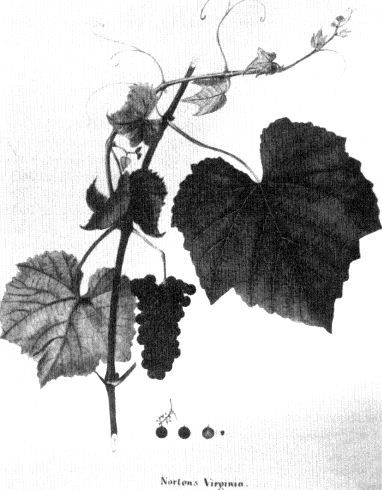
The history of US winemaking started as a fight between native varietals
Native Grapes, Norton
which didn't produce good wine, and vinifera based grapes which could produce wine but couldn't take the cold, rain, humidity, mold, fungus, and pests that were native to the New World. Bracketing that, the realization must be that while the Colonies were set up to be exporters of wine and silk to the Old World, the inputs to create wine took people, and the people were distracted by trifling things like getting enough food early in the New World's existence. Then there were the occasional wars, least of which was the one that started around 1776. People headed off to fight and nobody tended the vines. Some encouraging starts to winemaking were noted at various times after slave labor from indigenous Indians and Africa was added. The US Civil War then became another one of those events that put a damper on the production of wine and grape growing in the Eastern US.

Some bullet points of early winegrape growing and winemaking:

  • Grapes that can be used to make wine have been on the Continent of North America since before Leif Erikson discovered America in the year 1001. Seeing abundant vines he proposed to name the new country Vinland.
  • Paris Island in South Carolina is favored as the likely first place wine was made on the Continent in the
    East Coast in 1640
    year 1568 by Spanish colonists but that's not a commercial success.
  • Dr Laurence Bohune is the first winemaker whose name is known. He made wine from Native grapes in the year 1610 in the Jamestown settlement.
  • In 1672 Charles Calvert, the proprietor of Maryland laid out 240 acres of vines using a 'hogshed' of vines from Europe. The vineyard died the next year and as many other vineyardists at the time, suffered from the success of the tobacco industry which pulled people and resources away from wine experimentation.
  • Robert Beverly (b.1673 d.1722) was one of the largest of Virginia landowners and in 1705 wrote the first comprehensive history of Virginia, including the planting of his estate which he named Beverly Park.
  • In no colony before the Revolution was there any enterprise that systematically grew and harvested grapes, and then crushed them for wine outside of a few individuals who had modest production.
  • The first successful commercial winery in New York was founded in 1839 at Washingtonville on the Hudson. Its still in existence today under a successor name.
Lore notes some other likely places where commercial operations could have first started including Ohio, Georgia, North Carolina, Texas and California among others. Vinifera grapes were planted and never did well in the US East Coast which is why Jefferson was such a fan of Madeira wine. He couldn't get his vineyards to produce and wine from Europe often came spoiled. Wine from Maderia however was enhanced by the journey to the Colonies. That was a better bet for Jefferson than the local native wines made.

The first successful American wineries using vinifera grapes were established in drier conditions in El Paso in the New Mexico Territory. The region produced up to 200,000 gallons as early as 1846, but sadly that business died out soon thereafter for many reasons including the California Gold Rush which led to a massive migration west ..... that people component again closed out that business.

California's history books suggest the wine industry started with the Spanish Missions through Father Junípero Serra in 1769, but the first clear reference to the planting of grapes at a California mission comes from San Juan Capistrano in 1779; ten years after the arrival of the Franciscans in California. Besides, the secularization of the Spanish Missions in Texas and California in 1833 led to the nearly complete demise of mission wine production by 1844. So its hard to call that the start of commercial winemaking in the United States.

Mission Espada Chapel, Weches Texas
Of course Texans like to say they were first but then again, Texans like to think they are first in everything. Talking to a docent on a tour of the missions there a few years ago, the local perspective is Texas wine history was identical to California's with the establishment of Spanish Missions in the state in the 1650's, and since that predates California which likes to say they were first, they must be first - right? That's not entirely accurate because the Missions didn't operate commercial wineries. They made their wine for communion and made it from Mission grapes which never proved successful for commercial wineries. In fact the record shows the production from the Missions was never sufficient even for the Mission's sacramental needs.

General Vallejo who presided over the secularization of the Mission at Sonoma in 1835 has been given perhaps a little too much credit over the years in advancing the cause of US wine production in the North Coast of California, as he inherited his vines and replanted to some non-mission varietals, but produced only about 540 gallons of wine in total.


Image from a L.A. Wine Company 1876
Winemaking in Los Angeles started shortly after 1781 when a group of 11 families comprising 44 Mexicans settled by the river. Felipe de Neve, Governor of Spanish California, named the settlement "El Pueblo Sobre el Rio de Nuestra Señora la Reina de los Angeles del Río de Porciúncula." Right after the city name was thankfully shortened, grapes for wine were planted. It wasn't until 1833 that a Frenchman named Jean Louis Vignes imported European varieties to California by way of Boston and around the Horn and started making vinifera based wine. By 1846 the total non-native population of all of California was estimated to be no more than 8,000 while modest in size, that was the start of the California business nonetheless. In 1848 under the Treaty of Guadalupe Hidalgo, Mexico formally ceded California to the United States and wine in California took off after the Gold Rush population explosion. California just wasn't first in commercial wine production.

Wine Festival In Vevay, Indiana
The answer to the question is probably a little surprising to most Americans because the first successful commercial wine operation was in
Vevay, Indiana located along the Ohio river at the southern end of the State. The first vintage of wine was created in the year 1806 or 1807 using native grapes and production increased thereafter with 800 gallons produced in 1808, 2,400 gallons in 1810, and 3,200 gallons in 1812. The effort was influenced by John James DuFour who in 1825 wrote his treatise "The American Vinedressers Guide." The industry is continuing healthy in Switzerland County, Indiana to this day.

Here is the definitive wording from A History of Wine in America for all those who want to suggest another solution to the question:
 
 
That's it then. Indiana of all places. Go figure? As a final footnote, you probably noticed A History of Wine in America has 2 volumes. The first volume is the beginning to Prohibition and the second volume is from Prohibition forward. I've only used Volume 1 in this blogpost, but if you're interested in reading that, here is the Google e-books link: Volume 2.

So .....how did you do on the poll? I can tell you for a fact neither I nor my smarter friend got the right answer in our debate. I thought for sure it had to be in New York, Virginia, or maybe Texas if the US meant the land encompassing the current US and included the then possession of Spain.
Log in an offer your thoughts. How did you answer the poll and why?

What Does the End of QE Mean for Wine?

Everyone likes Fridays. This Friday is a little more special so I decided to post a non-Sunday blog for the first time. Why the deviation? Because Friday is the day we receive the most hours of sunlight in 24 hours .... and then its all downhill after that.

While that sounds a little gloomy phrased up that way, consider that its coming from someone who has been following and predicting the movements in the economy and wine business the past few years. Its been enough to make anyone gloomy especially since I've been consistently right. (Editors note: Please don't wake me and remind me of a forecast that was wrong. Thank you.)

Anyway, something happened yesterday that is making me put on economic sunglasses to protect my eyes: The Fed announced the economy is looking pretty darned good, inflation is in check, and unemployment is coming down to manageable levels. Add to that the US Credit Rating was raised back to AAA about 10 days ago and that is down right exciting right? What did the markets do? The Dow dropped 200+ points and the 10 year Treasury Bill rose 13 basis points. In fact the 10 year, which is the benchmark used for vineyard and acquisition financing has increased about 40 basis points since May. So what gives? If this is good news why is the market off and what does that mean for the wine business?


In conjunction with the other good news, the Fed announced they were going to pull the monetary sucker out of the Market's mouth of the toddler-like economic recovery, and targeted an end to their Quantitative Easing program starting early in 2014 and ending mid-year. The market has been feasting on cheap money for a long time and the announcement and timing was just a little more firm than many suspected, putting a damper on the investors mood.
 
Along with the announcement, the US dollar strengthened because there is now a higher return realized from investing in US$. In addition, the dollar also gained strength because the announcement demonstrated the US is not like Japan and won't be forever in a weak growth environment. A stronger dollar will mean we should see cheaper imports and that's a risk in a business that is running at balance to short in grapes and juice.

The announcement also signals an end to a cycle that has led to the lowest rates in the history of the US, and created a refinance stampede from wineries and vineyards in the past couple years. While the short term rates are for the present still low, the long end of the yield curve is trending up as noted to the left, and rates should continue to go higher based on this announcement. At some point in the next 24 months, it appears we are likely to see the short end of the rate curve start to rise as well.
 
Higher long term interest rates normally mean stabilized land values as higher interest costs mean larger property payments and a property can only produce so much in the way of cash flow so that lowers the sales price of land. In the case of vineyards, that may or may not prove out because the supply of vineyards is also lowish, and there has been a rush by many in the business to acquire new producing vineyards to support their programs driving land values higher. If this signals higher consumption levels, wineries will be looking for even more land. That's a long discussion and will have to wait for another Sunday.
 
The good news in all of this is the US Consumer is indeed making headway coming back and our economy is leading the World in showing recovery. Employed and confident consumers buy more wine, and higher priced wine. Higher bottle pricing will be needed if the wineries are going to be able to pass on the higher price of grapes that growers have been taking during the first half of this year. Consumers aren't quite there yet in being willing to spend more on wine but hopefully we will see that soon. That too is a blog post for another day.
 
Bottom line is the consumer is coming back so we might start spending our way back to prosperity .... which has always amused me ... that we can eat our way to prosperity, consume the worlds goods and be the envy of most other countries in the process. Doesn't that seem unnatural in some economic Darwinian way?

Back on point, this announcement signals rate increases will be coming. A 6% prime rate isn't that unusual. What happens to your winery's profitability if we see short term rates go up 3.00% in the next couple years at the same time consumers demand is growing and imports are cheaper?
 
Hopefully you've already locked in your capital and rate structure and got your piece of the cheap long term real estate money Ben Bernanke has been handing out, so your business wont be subject to a cycle of growth financed by higher priced debt in a margin strained wine industry.
 
Its a lot to digest and this barely touches the subject on the business and the changes we are going to see in this next cycle. For now I'd suggest you enjoy Friday because its all down hill after that ........... ( I'm talking about the hours of sunlight of course .....)
 

What do you think about the Feds announcement? Please sign in and offer your thoughts.

How Much Do Wineries Really Make?

Our most popular post from last year is brought current with the 2012 financial information. The question at hand is: "How much do wineries really make?
The answer of course is ......(drum roll please ....) Not enough. Finding the facts is almost as hard as chasing unicorns in this business because the wine business is private. Its a family owned industry with even the largest; Gallo a family owned company. But its really quite amazing from the perspective of what is shared between neighbors in the wine business. There isn't the sense that your neighbor is a rival or competitor. Its more of a club feel in many ways. If you need something, its quite normal to check in with your neighbor. Need a tractor because yours went kerput? No problemo. Need a little welding and custom fabrication on a pump? I'll be right over with a welding rig.
There is a competitive side that abounds in the business too of course. When it comes to sharing financial information and customer lists, good luck! Ask a winemaker neighbor how its going financially, and you'll get a mixture of liars dice, false bravado, partial truths and ..... well ..... the following video is the best explanation of how that game is played.......

It's no wonder our winery and vineyard clients at Silicon Valley Bank are drawn to our Benchmarking Database. Its not a guess or inflated bravado. The data in the set are composed of  thousands of reviewed and audited financial statements and they go back to 1990. We can group peers by region, varietals produced, business model and many other factors. You might be able to fool your neighbor on your cost of goods sold per case, or make a little white lie on your growth rate last year but as a banker, we get the real information so we are a little harder to fool. Our clients get free access to the averages and information produced, so they benefit by sharing. That kind of data doesn't exist anywhere else.

So back to the title question: How much do wineries really make? 6.9% pretax at the 2012 year end. That's a lot less than dreamy consumers imagine.


This chart is one that I present each year in the State of the Industry Report and use in most of my speeches. (You can see a larger view with by clicking on it.) Its a summation of the financial performance of the wine business since the 2004 calendar year. The tan-ish bars represent gross margin (sales minus the cost of sales), and the darker line is pretax profit. The lighter line is industry sales growth. You can back into total operating expenses as an expense if you are interested, by adding pretax profit and gross margin, and subtracting the sum from 100%.

What you notice from the chart is gross margin is far from consistent. Even if grape sales were constant, trade discounts and pricing opportunity will vary year to year changing the gross margin. But the reality is purchased grapes run through cycles and estate wineries have higher and lower costs of goods based on farming costs and yield. As you can see though, gross margin and then profit do move in waves.

What's happening right now? We are seeing producers starting into an era in which their gross margins are and will be squeezed. You can see the impact of price discounts from 2007 to 2009 where we found bottom out of the recession. Then in 2010 and 2011 we saw improved conditions as grape costs fell off their pre-crash levels and . Today we are experiencing the higher costs of light yields in 2010 and 2011 which in 2012 were offset by reigning in promotions and discounts.

In 2013, we will start to see the higher grape costs from 2012 entering the income statements. Those costs aren't fully passed on to the consumer which means those pre-tax profit margins you see are likely to fall a bit in the next several years, at least on average.

There will always be some neighbors who do better than others. I'll bet our imaginary neighbor didn't know what was happening with the industry benchmarks .... or did he?


This is the appropriate time to add .... the preceding "film" contains statements and opinions which are fictional in nature. Any similarities to real people or wineries are purely coincidental and unintentional. And besides, no winery owner I know would be caught dead in that red sweatsuit looking like they were wearing a diaper. I've never met anyone like that.

Anyway - those are the facts on winery profitability and the bottom line. Wineries are being squeezed and in our opinion are likely to see more of that in the near term being unable to pass pricing increases to consumers. Economically, we may start to see improvement in the back half of 2013 and that may help somewhat.

Those are our thoughts. Feel free to weigh-in and offer your thoughts and comments below.