
 |
| The Best View of the Housing Bubble Pre-Crash |
I recall giving a speech in August of 2008 to about 125 growers and winery owners. The speech was on the economy and I pulled up the slide above to demonstrate what I was seeing ahead of us. This was at a time just after Lehman Brothers collapsed where it had become apparent that we had crested a market high in housing and entering a bearish period. What the chart says in brief, is the historical average ratio of existing home price divided by median 4 family income is 2.8 times. That's what the red line is. With a ratio of 2.8 times, if a family made $100,000 a year, they could afford a $280,000 home. You can see what happened by late 2006 into 2007.
 We are taught in school that in economics, measures have a tendency to revert to the mean. But talking heads everywhere were suggesting back then that what we were experiencing was a normal correction. Maybe, but the chart above along with some other indicators told me otherwise and I suggested we were about ready for a nasty correction and reversion back to the mean, and that correction was going to be huge and take years based on the slope of that line.
  If that weren't enough, I also suggested the growth rate in wine would fall to flat (zero percent) growth. I really thought there was a strong chance wine sales growth could go into negative territory for the first time in memory - but predicting that would get me permanently banned from the Economic Optimists Union so I fudged up a little on the forecast. I was actually being optimistic on what was ahead for us, but people didn't hear it that way. My speaking invites started falling like the stock market. I've never been invited back to speak in front of that Grower Association again. From all sides the message was, "If you don't have good news to report, then we'll find someone who can." Well, OK then, go ahead and listen to your excessively optimistic speakers and see if I care. My dog still likes me and my mom still ...... well ...... my dog still likes me anyway.
"The housing correction poses the biggest risk to our economy. Our economy and our markets will not recover until the bulk of this housing correction is behind us." Treasury Secretary Henry Paulson, 11/12/2008

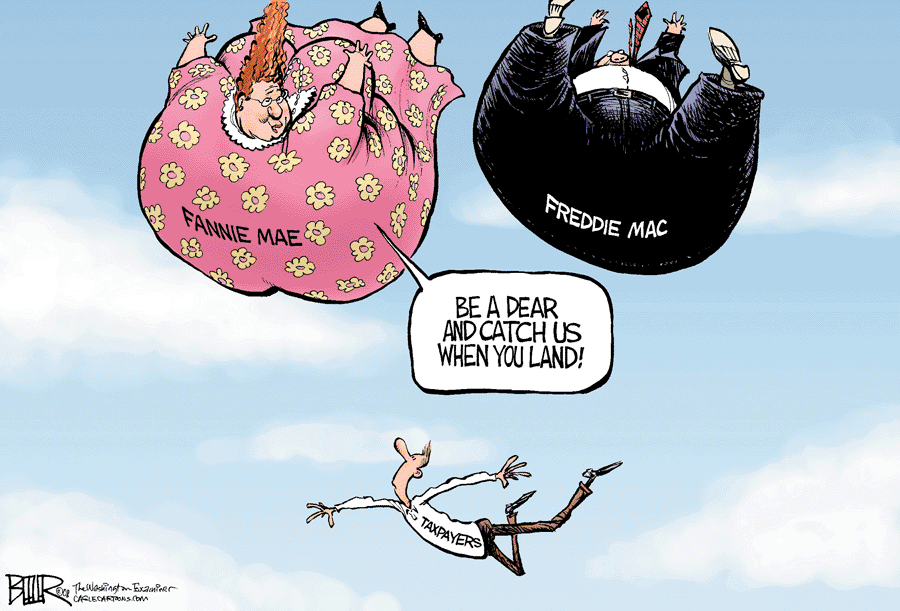 So where are we today? Fannie is actually starting to repay the bailout money (Self serving note: the Bank bailout through TARP was paid back with a sizable profit to tax-payers thanks to the strings Paulson put on that Bailout.) Of course Detroit is now going Bankrupt, but the American Auto Industry was able to rationalize their insane Union compensation plans, and has a chance to pay back a large part of that bailout, if not all of it .... well most of it anyway. The economy isn't healed but the most recent Case-Shiller Index had this happy news last week:
 "As of May 2013, average home prices across the United States are back to their spring 2004 levels. Measured from their June/July 2006 peaks, the peak-to-current decline is approximately 24 to 25 percent. The recovery from the March 2012 lows is 16.5 percent for the 20-city index."

 |
| Consumer Comfort Index at 5 year high |
In the SVB State of the Wine Industry Report released in January, we predicted bumpy going in the first half of the year and an upturn in the back half with average fine wine sales growth in the 4% - 8% range. While there are still plenty of variables out there that can throw that forecast off, I think at this stage with the good news in housing and retail sales hanging in still, its remains a good forecast.
The middle class consumer is showing resilience, housing is now below 6 months of inventory which typically signals a short market, and the Fed is talking about ways to slow their bond purchases in response to what seems like a healing economy. We have a lot to look forward to in the last half of the year, and I'm hoping my pre-recession gloomy speeches will be forgiven by the organizers in hindsight, and maybe my phone will ring again since I have happy news to report? Oh well ..... at least my dog loves me.


