Tampilkan postingan dengan label SVB. Tampilkan semua postingan

Bra-Burning Feminists Drive Wine Sales

The business world moves in cycles, and if you live long enough you start to see them repeat. Today the popular press is replete with articles hyping the Urban Millennial Myth.

Its the older tradition-loving Boomers who have become accustomed to Madison Avenue solving every need, want and desire - versus the edgy up-and-coming Next Generation. The Next-Gen is nothing like you've seen before and you need to get current with your marketing or you will end up on the losing end of the stick.... or so many would have you believe ... except its really a repeat of a cycle we've seen before and we can see the outcome.

Cycles & Susan B. Anthony


Boomers today drive wine sales and its the women Boomers who are the primary wine buyers according to many studies. Those were the the same bra-burning feminists that were labeled as radicals back in the 1960's and early 1970's when they were Millennials. They were nothing like we've ever seen before either .... well .... there was Susan B. Anthony in a prior cycle but that's another story.

If you decided to craft a label to attract Millennials today, what would that look like? The press tells us Millennials are adventuresome, irreverent and demand transparency, sustainability and authenticity. What about their desired product attributes in a wine purchase? What do they want?

An article that came out last week says Millennials are looking for non-pretentious products, non-traditional packaging, simple wines at an affordable price that speak to them; each are reported solutions for cracking the Millennial Code and developing a successful wine marketing program to that untapped pot of gold at the end of the cohort marketing rainbow.

Rima Fakih (Photo courtesy of Miss Michigan USA)
A restaurateur who targets Millennials, answers the question within the article noted above by talking about how he decided to create wine lists that ...
"...flout the bureaucratic rules that dictate how wine should be made. It’s an eclectic, slightly subversive list with a decidedly anti-authoritarian bent."
The description of Millennials and what they like sound eerily familiar ... non-traditional packaging, simple wines at an affordable price.... transparency, authenticity, adventure, irreverent behavior.....


Boom-illenials
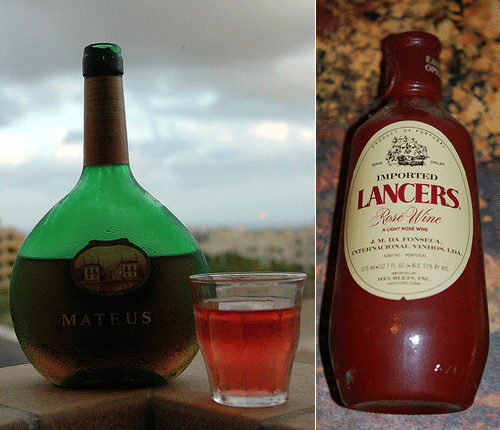

Back to cycles - there was a day when the Boomers weren't traditionalists either. In the 1960's we Boomers wanted transparency... except we called it Government lies. We wanted authenticity ... except we called it "getting real." We leaned toward being irreverent, and were called radicals. We were part of the Occupy Movement  ... except we called the event a "sit-in." And we also drank wine - mostly inexpensive sweet wines; Blue Nun, Reunite (on ice ...), Grey Riesling, Mateus, Lancers, Rhineskeller, Paul Mason wine in carafe's, etc.

Those brands were the wine companies solutions for marketing to the Boomers in that era .... wines from non-traditional regions and presented in non-traditional packages, emphasizing fun, adventure, and sex appeal. We were really anti-authoritarian, sustainably-green. Heck, we even recycled the Lancers bottles as candle holders! Millennial current day likes and dislikes are very similar to what came before them so there is a road map and we are seeing the same thing happening with the growth in Rieslings as an example, and the multitude of packaging.

Radical Feminism and Wine

 
Maybe Susan B Anthony didn't let liquor touch her lips, but Boomer women have been found in several studies to let a lot of wine touch their lips, and and one can argue women Boomers are the most important wine cohort today. In one study, The Wine Market Council recently estimated 53% of people who drink wine more than once a week are women. Maybe someone should have marketed to them back in the 60's? Radical feminists as they were called in the 1960's, brought attention to their second-class plight by casting their makeup, high heels, girdles and bras into trash cans labeled "Freedom Trash Can" at the 1968 Miss America Pageant.  In a decidedly anti-authoritarian manner, everything was tossed into the can and it was set afire.  
Gloria Steinem is one of the best known feminists. She was at the epicenter of women who were burning their bras at the Miss America Pageant and working for positive change for women in our culture. Where did she end up? She's spent her life trying to advance the cause of women, but she's mellowed and become less radical and more traditional  today. When she was recently asked to opine on Miley Cyrus vulgar dance (!generation gap alert!) at the VMA awards, this was her response:  
Gloria Steinem
".... given the game as it exists, women make decisions. For instance, the Miss America contest is in all of its states ... the single greatest source of scholarship money for women in the United States. If a contest based only on appearance was the single greatest source of scholarship money for men, we would be saying, "This is why China wins." You know? It’s ridiculous. But that’s the way the culture is. I think that we need to change the culture, not blame the people that are playing the only game that exists." (highlighted for emphasis)
Wow! That's a huge evolution for Gloria Steinem. Not only did she not condemn the Miss America Pageant, she applauded the contestants for doing what they could do. Apparently, even the most radical among us will evolve over time.  

Should I Market To Millennials Now?

Looking at how Gloria Steinem has evolved, do you think a brand created for her in the 1960's would still be effective today? I've heard the argument from many that its important to market wine to Millennials now, so they will be the next generation of wine drinkers. If you make $10-$20 wines as a mainstay, then by all means - market to Millennials because they might buy your wine today. But if you are making wines that are $20+ wines, then you are wasting your scarce marketing dollars.
All that said, if we want to have Millennials learn to love American wines when they are in their thirties, that is an American Wine Industry issue. No question in my mind that the younger generation has access to and is drinking better foreign wine than the Boomers at a similar point in life. That should be a concern to the US wine industry and we should be looking at putting a Wine Marketing Order in place.
Take a clue from history. Were you to make a wine that appealed to the 60's Bra-Burning Radical Boomer Feminists when they were in their early 20's .... brands like Blue Nun, Grey Riesling, Mateus, Lancers, Rhineskeller, Reunite, Paul Mason wine in carafe's, etc. .... your branding would have been wasted just like those brands have wasted away to being gone or almost gone. The women who consumed those wines back then today really don't drink those wines.  In the same way, there is little chance that the Millennial will develop loyalty to your brand that hits all their wants and desires now, and who stays with your brand forever because you were first to their party. Why? Because their tastes will change and when they have the money to make impactful purchases of your $20+ wine, they will be off to something else. History will repeat itself.
 

Millennials Are Last in Wine Spending

 
In the article I mentioned above, we sadly find the seemingly requisite and misleading stats that overstate the Millennials importance in current wine consumption, contributing to the growing urban myth by saying,   
"...about 39 million U.S. adults drink wine several times a week. Millennials make up 29 percent of that group, while 39 percent are baby boomers." A quick read of that might lead one to believe Millennials are #2 in spending and right on the heels of Boomers. But if any cohort is on the heels of Boomers, its the ignored Gen X cohort, and it really doesn't matter which price point we're discussing as you can see in the chart above. Millennials are last in terms of spending on wine. I discussed the Millennial myth in greater detail a couple weeks back in the post Millennials Aren't All That.       

Urban Myths and Women

I challenge anyone to find a reliable statistic that shows Millennials are spending more on wine than Boomers or Gen X'ers today. If you believe that to be true, then you've been sucked in by the Urban Myth of Millennials..... just like the myth of women burning their bra's in the 1968 Miss America Pageant. True story .... that never happened either. Nobody burned their bras at the Pageant and it was rare that anyone ever did. Its just another urban myth that keeps getting repeated over and over again until it starts being true, exactly like the Millennial Myth that is advanced into urban legend by self serving reports and reporters. The reality is that what you read in the press (and stupid blogs for that matter) ... what's written isn't always true. Deciphering the truth can at times be perplexing, but from every angle available - what is clear to me is Millennials will evolve just like the Boomer women evolved, moving from gimmick wines and unique packaging, to more structured wines, and then to fine wine. Of course that's a generalization and you can just as easily argue not all will evolve that way and I would agree. For now though, Millennials shouldn't be the targets of most family winery marketing programs today. Gen X should be your growth engine and Boomers should be your "cash cow."
The Feminism Movement made enormous strides for women's rights but with wine, there is more work to be done. In an article three years ago, a Master Sommelier pointed out 80% of the time a male/female couple sits at a table together, its still the man who is given the wine list and expected to make the decision. I'm thinking women deserve an equal chance to grab the list and suggest the practice of putting the list in the middle of the table makes the most sense.
And finally to Gloria Steinem, turns out she is a Boomer and a wine lover - go figure. If you are interested, and are planning on being in New York on December 23rd, you can see her at the City Winery with the musical group BETTY and ask her what she thinks.  

What are your thoughts? Please log-in and offer your comments for the community and if you think the read is worth passing along on your favorite social media platform, I'd appreciate it!

Experiment or Die


Stupid mistakes and do-overs. Come on. Admit it. You've made your share. I made a similar mistake to the lumberjack in the above video. Trying to save a couple hundred bucks by not hiring a professional, I cut a tree limb away from my sliding glass door. Cutting straight down with a chain saw the limb cracked and held together by the fibrous bark. Like a hinge it pivoted down, perfectly connecting with the glass door below shattering it to pieces. It cost me $1,200 to replace the door and I've never made the same mistake since.

How does your organization treat failure? Are mistakes something that end up in performance reviews, or brought up later in a conversation when a point is being made? Failure is a component of learning and innovation. Do you have a philosophy surrounding failure in your business culture? Are there written values that talk about the process of innovation?

We have a lot of experienced people at Silicon Valley Bank and a long culture of innovation. Those people have had the most opportunity to make mistakes so you can argue are the biggest failures. After 30 years since our founding, the bank has been trying various things to celebrate the milestone. One thing we're doing is offering 30 weekly pearls of wisdom from people who've been here the longest. This week marked my 24th year at the organization and coincidentally my quote was the one shared this week.

The World According to Rob

The way I see the world, there are tactical failures and strategic failures. On the strategic side of things you have to be able to try old things in new ways, or discover brand new solutions. Why? Because the world and business is evolving every day. In fact I think the wine business is operating under something of a Moores Law and the pace of change is redoubling at an exponential rate. Are you keeping pace?

Weapons of Mass Culture Destruction

So many business cultures are full of doubt. "What? That's a crazy idea. That will never work..." Ever hear that one? I can't tell you how many times someone, in response to a new idea asks me: "Who has ever done that before?" as if we have to have someone else as a template before trying something new. If that is your culture, you will never be an industry leader. You will never be first to market and have a first-mover advantage. Sure there is a risk in failing, but if you judge people by their failures, then they are failures. Judge instead by their successes. If you really want to judge by failures and you are a hiring manager, then you better look in the mirror because you hired them making you the real failure. Apparently you would rather hire lemmings who don't take risk versus hiring people who are willing to try and fail.  

If you aren't allowing people to experiment and fail to evolve the business, you will die because your competitors will blaze by you. You might also look at management because there is potentially an issue of managers asserting control instead of allowing employees to use their God-given talents to succeed in the manner in which they will be the most successful.

But they are always making mistakes!!


Sometimes the best answer is the simple one
It's not the volume of mistakes made. Its learning and improving from the mistakes that really is important. If someone can't learn, then maybe they aren't in the right job. But if you hide daily mistakes, I guarantee the mistakes will continue, particularly in tactics and daily execution.

I worked in an organization years ago that had a fear of failure. In fact I remember being told by a senior person, "The first rule of banking is: Blame someone else." Making mistakes in that culture was a certain way to have a short career. Guess what? Few people have long careers there unless they get really good at deflecting blame and playing politics. The culture sucks. What happens in that environment? Mistakes get buried. You never can help people grow because all mistakes are magnified, they show up on your performance evaluation, and client care suffers because you can't address hidden issues. Failure happens still. It just goes underground and everyone walks around talking about what an awesome job they are doing because its a mistake-free environment.


Celebrate Failure !!

My view is you have to develop a culture that celebrates failure because failure is a key component to success. You have to have values embedded in the business culture that reward and encourage those who try and fail. Failure is a form of tuition. You paid the tuition so you might as well harvest the learning and evolve. If you lack business values that protect this critical success element, your company is already dying. 

Here are some other thoughts to consider in your winery business culture:
  • Does your culture have the puritan ethic to punish failures?
  • Do old mistakes get brought up in passive-aggressive ways? "Oh boy. That sure didn't work out .... haha."
  • Are those who naturally have ideas given a platform for you to harvest their thoughts?
  • Do those who question process get an open opportunity to voice their solutions without fearing political backlash from others supporting or running a business process?
  • Do your managers use ideas that come from others and then give credit where credit is due? or ... Do they take the credit themselves for ideas?
  • Do managers ignore other's ideas and only implement their own to elevate themselves?
  • How do you know you have a culture that has a wide funnel to hear new ideas? Are you only talking to managers?
  • Do you have a stated business perspective regarding innovation and failure, or is it left unsaid because "everyone gets it?"
  • Are successful ideas given lavish attention? Or are successes no different that any other positive thing in business?
  • Are failures talked about openly so everyone can learn? Or are the feelings of the people considered first? In an environment that truly celebrates failure, open discussion of failure is no big deal.

What do you think? Any examples of successes or failures from your past? Any thoughts about the way successful and unsuccessful companies create a culture surrounding innovation and failure? Is there anything here that stimulates your thinking and resolve to effect change?


Please log in and share your thoughts with the community, and by all means - share the discussion in your favorite social media platform.


Do You Know the Location of the First Successful Winery in the US?


This week we're moving off the normal marketing, economy, and business issues and asking a basic question anyone working in the US wine business should know:"Where was the first successful commercial winery in the United States?" Do you know? I confess I didn't know for sure. I remember thinking Jefferson was a really important figure in American wine and he worked at establishing a commercial presence in Virginia early on, so maybe Virginia was first? Surely with the native vines in existence, there must have been a successful wine businesses established before the time of Jefferson?

I had this debate over a bottle of wine with someone smarter than I last week. The discussion of "firsts," depending on where you live and who is telling the story can change dramatically, so the interwebs - which everyone knows is the possessor of all that is true - can sometime provide false information. The reality is the real beginning of the US Wine business has been butchered in history books and folk-lore. There is however a definitive rendering of the subject.

If you haven't ever read A History of Wine in America, I highly recommend spending the time to do so. I've even linked a free Google e-book to the above title so you have no excuse. The book sheds a bright spot light on the subject and will have you the envy at your next party where you win the attractive table centre piece for getting the right answer. That said, I know many of you are Cliff Notes kind of people and wont spend time in the book, so if you want the shortcut to the answer, read on.
 

The history of US winemaking started as a fight between native varietals
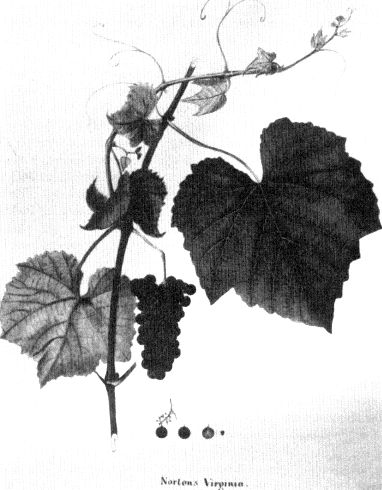
Native Grapes, Norton
which didn't produce good wine, and vinifera based grapes which could produce wine but couldn't take the cold, rain, humidity, mold, fungus, and pests that were native to the New World. Bracketing that, the realization must be that while the Colonies were set up to be exporters of wine and silk to the Old World, the inputs to create wine took people, and the people were distracted by trifling things like getting enough food early in the New World's existence. Then there were the occasional wars, least of which was the one that started around 1776. People headed off to fight and nobody tended the vines. Some encouraging starts to winemaking were noted at various times after slave labor from indigenous Indians and Africa was added. The US Civil War then became another one of those events that put a damper on the production of wine and grape growing in the Eastern US.

Some bullet points of early winegrape growing and winemaking:

  • Grapes that can be used to make wine have been on the Continent of North America since before Leif Erikson discovered America in the year 1001. Seeing abundant vines he proposed to name the new country Vinland.
  • Paris Island in South Carolina is favored as the likely first place wine was made on the Continent in the
    East Coast in 1640
    year 1568 by Spanish colonists but that's not a commercial success.
  • Dr Laurence Bohune is the first winemaker whose name is known. He made wine from Native grapes in the year 1610 in the Jamestown settlement.
  • In 1672 Charles Calvert, the proprietor of Maryland laid out 240 acres of vines using a 'hogshed' of vines from Europe. The vineyard died the next year and as many other vineyardists at the time, suffered from the success of the tobacco industry which pulled people and resources away from wine experimentation.
  • Robert Beverly (b.1673 d.1722) was one of the largest of Virginia landowners and in 1705 wrote the first comprehensive history of Virginia, including the planting of his estate which he named Beverly Park.
  • In no colony before the Revolution was there any enterprise that systematically grew and harvested grapes, and then crushed them for wine outside of a few individuals who had modest production.
  • The first successful commercial winery in New York was founded in 1839 at Washingtonville on the Hudson. Its still in existence today under a successor name.
Lore notes some other likely places where commercial operations could have first started including Ohio, Georgia, North Carolina, Texas and California among others. Vinifera grapes were planted and never did well in the US East Coast which is why Jefferson was such a fan of Madeira wine. He couldn't get his vineyards to produce and wine from Europe often came spoiled. Wine from Maderia however was enhanced by the journey to the Colonies. That was a better bet for Jefferson than the local native wines made.

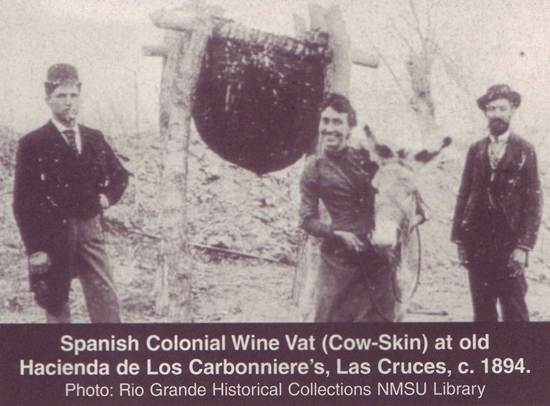
The first successful American wineries using vinifera grapes were established in drier conditions in El Paso in the New Mexico Territory. The region produced up to 200,000 gallons as early as 1846, but sadly that business died out soon thereafter for many reasons including the California Gold Rush which led to a massive migration west ..... that people component again closed out that business.

California's history books suggest the wine industry started with the Spanish Missions through Father Junípero Serra in 1769, but the first clear reference to the planting of grapes at a California mission comes from San Juan Capistrano in 1779; ten years after the arrival of the Franciscans in California. Besides, the secularization of the Spanish Missions in Texas and California in 1833 led to the nearly complete demise of mission wine production by 1844. So its hard to call that the start of commercial winemaking in the United States.

Mission Espada Chapel, Weches Texas
Of course Texans like to say they were first but then again, Texans like to think they are first in everything. Talking to a docent on a tour of the missions there a few years ago, the local perspective is Texas wine history was identical to California's with the establishment of Spanish Missions in the state in the 1650's, and since that predates California which likes to say they were first, they must be first - right? That's not entirely accurate because the Missions didn't operate commercial wineries. They made their wine for communion and made it from Mission grapes which never proved successful for commercial wineries. In fact the record shows the production from the Missions was never sufficient even for the Mission's sacramental needs.

General Vallejo who presided over the secularization of the Mission at Sonoma in 1835 has been given perhaps a little too much credit over the years in advancing the cause of US wine production in the North Coast of California, as he inherited his vines and replanted to some non-mission varietals, but produced only about 540 gallons of wine in total.


Image from a L.A. Wine Company 1876
Winemaking in Los Angeles started shortly after 1781 when a group of 11 families comprising 44 Mexicans settled by the river. Felipe de Neve, Governor of Spanish California, named the settlement "El Pueblo Sobre el Rio de Nuestra Señora la Reina de los Angeles del Río de Porciúncula." Right after the city name was thankfully shortened, grapes for wine were planted. It wasn't until 1833 that a Frenchman named Jean Louis Vignes imported European varieties to California by way of Boston and around the Horn and started making vinifera based wine. By 1846 the total non-native population of all of California was estimated to be no more than 8,000 while modest in size, that was the start of the California business nonetheless. In 1848 under the Treaty of Guadalupe Hidalgo, Mexico formally ceded California to the United States and wine in California took off after the Gold Rush population explosion. California just wasn't first in commercial wine production.

Wine Festival In Vevay, Indiana
The answer to the question is probably a little surprising to most Americans because the first successful commercial wine operation was in
Vevay, Indiana located along the Ohio river at the southern end of the State. The first vintage of wine was created in the year 1806 or 1807 using native grapes and production increased thereafter with 800 gallons produced in 1808, 2,400 gallons in 1810, and 3,200 gallons in 1812. The effort was influenced by John James DuFour who in 1825 wrote his treatise "The American Vinedressers Guide." The industry is continuing healthy in Switzerland County, Indiana to this day.

Here is the definitive wording from A History of Wine in America for all those who want to suggest another solution to the question:
 
 
That's it then. Indiana of all places. Go figure? As a final footnote, you probably noticed A History of Wine in America has 2 volumes. The first volume is the beginning to Prohibition and the second volume is from Prohibition forward. I've only used Volume 1 in this blogpost, but if you're interested in reading that, here is the Google e-books link: Volume 2.

So .....how did you do on the poll? I can tell you for a fact neither I nor my smarter friend got the right answer in our debate. I thought for sure it had to be in New York, Virginia, or maybe Texas if the US meant the land encompassing the current US and included the then possession of Spain.
Log in an offer your thoughts. How did you answer the poll and why?

Is Demand for Wine Dropping?


I saw the above video last week referencing demand for wine and the title got my attention. Is the demand for wine really falling? When you watch the video above many people might think so, but I don't really put a lot of faith in LiveEx as a measure of demand for fine wine. This might be speaking to Bordeaux largely and LiveEx might have use in other areas but not for overall consumer demand.

Last week we did a version of a Mid-Year State of the Industry Blog, but in it noted that its hard to do a State of Anything in a blog so we left out consumer demand. With this video clip from Bloomberg hitting the interwebs, I thought it might be worthwhile to debunk the above perspective.

In the 2013 SVB Annual Wine Report we predicted sales growth between 4% and 8% in the fine wine segment. One of the factors that we considered in the forecast was the expectation of a rough first part of the year as sequestration kicked in, pulling back the growth rate in demand. But we also believed the back half of the year would be better as we bottomed in the housing market and the consumer started loosening their purse strings.

It seems as though we were pretty close in the blue-print, but at this stage it appears sequestration didn't have the dire impact many in Washington predicted and in fact has improved the Debt to GDP ratio to the point where our Debt Rating was upgraded again to AAA. We have seen the bottom of the housing market and continue to see improvement in consumer and retail spending though it remains to be seen how we did predicting the back half of this year. That said, according to information provided from Wines & Vines in cooperation with IRI, off premise sales through July are up 7% for 12 months.

Moving to one more perspective, a compilation of data provided by Demeter Group shows continuing growth in overall US consumption, consistent with flat to declining hectares of production. That gap between what is planted and what is consumed is being met with imports. The 2012 harvest size at this point in the year has slowed down the continual march upward of the growth in market share for imported wines. That said, as of this writing and as mentioned last week, the harvest in the Southern Hemisphere appears good, and with the US Economy still seemingly recovering ahead of the rest of the world, one has to believe the dollar should strengthen against a basket of currencies thus favoring import growth.

Of course this is such a big topic and only a small top-of-mind commentary on where we sit today, but I don't want to lose my Blogger Credential that requires brevity in prose. Hopefully this is enough for you to agree with me the Bloomberg video above isn't properly representing the state of consumer demand in the US. Consumer demand for wine continues to rise by all measures and if our early year forecast proves out, should increase YOY through the end of 2013.


What are your thoughts? Please log in and offer your views about growth in wine sales and consumer demand at this point in the year.


Is Your Tasting Room Successful?


It's your fault!
The other day I  stopped in at Wal-Mart to get some things. While checking out, a very large woman in very tight clothes came up from just outside the store and angrily told my cashier she lost her debit card after she paid. While I looked around the floor for the card the cashier said, "Yes, I remember you putting it back in an envelope" to which the woman replied, "Its not in there. I put it in the envelope but you rushed me to get out of line. You rushed me. I want to see your manager!"  ..... Are you kidding me? I had to work at holding my tongue.

What is it about the human condition that makes it so hard to accept personal responsibility? A similar version of that is the medical condition known as ....

Headinthesanditosis.


Quite sometime ago I had a client come in the office to talk. Already three vintages behind the market and unable to meet financial obligations, it was time to have a direct discussion about viable solutions. She was really quite an intelligent person but before we could even get to the part where we discussed alternatives in her control like sales strategy, ranking distributors success, branding, market presence, pricing strategy, proper cost allocations, ways to use inventory to raise cash, etc., I was offered the following:
"Its not like I'm the only one with financial problems. The whole industry is suffering and not current with releases. The only problem I have is you wont give me more money."
I had to tell her the view she held of the market was askew. We didn't have any other clients who were three vintages behind and in fact because of our financial benchmarking database, I was able to show her just how far out of the norm she was. She was so shocked at the information (see her in shock in the picture ----> ), that rather than accept what was in front of her, she instead tried to poke holes in the database. "Wait, are there foreign wineries in there?"

What is it about the human condition that makes us stretch the bounds of credulity rather than accept it when we aren't measuring up?

Tasting Room Success


That gets us to the point of this blog. Is your tasting room successful? How do you know? What are you measuring success against? Is the tasting room making enough money? What is enough money for the tasting room? Are your staff salaries in line with the market or are you overpaying? Is your club retention long or short of average? What's your conversion rate of visitors into club members?

Hopefully unlike the woman I ran into in Wal-Mart, you understand if it's someone else's fault, your destiny is in someone else's control. So you instead are an enlightened person and crave metrics from which you can diagnose where there are opportunities to succeed, and when you are operating within or below tolerances. Hopefully you want to find as many measurements as you can, and then rank where you can get the best returns  by investing your time and money in those. and moving past or eliminating things that give you minimal or negative returns.


You probably measure club membership length and your results are better than what is portrayed on the slide above (click on it for a larger view). On average, club memberships last just a little over 2 years. That means someone probably came into your tasting room, they signed up, and got their first shipment. When they got their second shipment the next year, they decided to leave the club. That is horrible performance in my view. It cost so much money to get the first sale in the door when you fully burden that sale with the overhead and salaries of the tasting room staff. You probably didn't really make money on that first sale. Then you shipped a second case the following year and they quit the club.
 
If you want to make money out of the tasting room, this is one metric that has to be improved upon. Furthermore, about those people that left - why did they leave? If I have to presume, I'd guess they didn't like what you shipped, but when I ask that question of some, I can get answers that reflect they really don't know why people left the club. Its not uncommon to start in with... it was probably the economy... maybe they lost their jobs ... they could have lost their house and there was no forwarding address ....or maybe the dog ate my homework? 
 
What is it about the human condition that makes it so hard to want to dig out facts that could point to someone dissatisfied with our product and services? Shouldn't we know why they left so we can address any issues?
 
On Tuesday morning of this week, Wine Business Monthly and Silicon Valley Bank will be hosting a live video conference on Tasting Rooms, CRM, Direct Sales, and Wine Clubs. We've had over 500 wineries participate in the survey and found some really interesting information that you can use to benchmark your own winery's performance. Its being offered gratis and I hope you can join in.
 
Videocast
May 21, 2013
Register Now
 
 
What do you think? Why do people not benchmark their performance? Why is it so difficult at times to ask someone how we can improve? Why are wine club customers turning over every 2 years in the wine business? Log in and offer your thoughts below.

How Much Do Wineries Really Make?

Our most popular post from last year is brought current with the 2012 financial information. The question at hand is: "How much do wineries really make?
The answer of course is ......(drum roll please ....) Not enough. Finding the facts is almost as hard as chasing unicorns in this business because the wine business is private. Its a family owned industry with even the largest; Gallo a family owned company. But its really quite amazing from the perspective of what is shared between neighbors in the wine business. There isn't the sense that your neighbor is a rival or competitor. Its more of a club feel in many ways. If you need something, its quite normal to check in with your neighbor. Need a tractor because yours went kerput? No problemo. Need a little welding and custom fabrication on a pump? I'll be right over with a welding rig.
There is a competitive side that abounds in the business too of course. When it comes to sharing financial information and customer lists, good luck! Ask a winemaker neighbor how its going financially, and you'll get a mixture of liars dice, false bravado, partial truths and ..... well ..... the following video is the best explanation of how that game is played.......

It's no wonder our winery and vineyard clients at Silicon Valley Bank are drawn to our Benchmarking Database. Its not a guess or inflated bravado. The data in the set are composed of  thousands of reviewed and audited financial statements and they go back to 1990. We can group peers by region, varietals produced, business model and many other factors. You might be able to fool your neighbor on your cost of goods sold per case, or make a little white lie on your growth rate last year but as a banker, we get the real information so we are a little harder to fool. Our clients get free access to the averages and information produced, so they benefit by sharing. That kind of data doesn't exist anywhere else.

So back to the title question: How much do wineries really make? 6.9% pretax at the 2012 year end. That's a lot less than dreamy consumers imagine.


This chart is one that I present each year in the State of the Industry Report and use in most of my speeches. (You can see a larger view with by clicking on it.) Its a summation of the financial performance of the wine business since the 2004 calendar year. The tan-ish bars represent gross margin (sales minus the cost of sales), and the darker line is pretax profit. The lighter line is industry sales growth. You can back into total operating expenses as an expense if you are interested, by adding pretax profit and gross margin, and subtracting the sum from 100%.

What you notice from the chart is gross margin is far from consistent. Even if grape sales were constant, trade discounts and pricing opportunity will vary year to year changing the gross margin. But the reality is purchased grapes run through cycles and estate wineries have higher and lower costs of goods based on farming costs and yield. As you can see though, gross margin and then profit do move in waves.

What's happening right now? We are seeing producers starting into an era in which their gross margins are and will be squeezed. You can see the impact of price discounts from 2007 to 2009 where we found bottom out of the recession. Then in 2010 and 2011 we saw improved conditions as grape costs fell off their pre-crash levels and . Today we are experiencing the higher costs of light yields in 2010 and 2011 which in 2012 were offset by reigning in promotions and discounts.

In 2013, we will start to see the higher grape costs from 2012 entering the income statements. Those costs aren't fully passed on to the consumer which means those pre-tax profit margins you see are likely to fall a bit in the next several years, at least on average.

There will always be some neighbors who do better than others. I'll bet our imaginary neighbor didn't know what was happening with the industry benchmarks .... or did he?


This is the appropriate time to add .... the preceding "film" contains statements and opinions which are fictional in nature. Any similarities to real people or wineries are purely coincidental and unintentional. And besides, no winery owner I know would be caught dead in that red sweatsuit looking like they were wearing a diaper. I've never met anyone like that.

Anyway - those are the facts on winery profitability and the bottom line. Wineries are being squeezed and in our opinion are likely to see more of that in the near term being unable to pass pricing increases to consumers. Economically, we may start to see improvement in the back half of 2013 and that may help somewhat.

Those are our thoughts. Feel free to weigh-in and offer your thoughts and comments below.

Are Immigrants taking American Jobs?


Immigration is a hot topic bracketed by views from the right and left that aren't predictable based on party affiliation.... maybe because the Hispanic vote has taken on such a high priority for the 2014 elections? From the Ag perspective, getting a sufficient supply of legal farm help has continued to be an increasingly difficult task forcing many farmers to use whatever help they can find. While the Wine Business is not as dire given the higher wage paid, you're foolish to think the current debate wont have any real impact here given the breadth of the discussion.

Some of the questions raised: Is it really fair to give a free pass to people who have ignored the laws of the State and are here illegally? Should you deport families whose children are born in the US and are citizens? Is it fair to taxpayers to be forced to educate illegal immigrants when our education system is in such a poor state? Is it fair to have Americans pay for illegal immigrant's medical expenses when they go to an emergency room? Are they taking jobs from Americans? You might think the jobs are low wage, but what about the high-paid jobs that are being filled by immigrants under the H1-B Visa program? Wouldn't Americans want those jobs? Under the Bill, estimates are that we will be granting up to 1.1 million illegal farm workers some measure of a legal status. Does that make sense?


Illegal Immigrants


Senator Dianne Feinstein (D-CA) authored a section in the proposed Immigration Bill that addresses the farmworker shortage specifically. She said she wanted to find a way to "create a professional class of skilled agricultural laborers." Under Feinstein’s proposal, undocumented workers who work at least 100 days over two years would be given an agricultural “Blue-Card.” Blue-Card holders would then need to work for an additional 500 days over five years, or 450 days over three years to get permanent residency. Getting that “Green-card” permanent status is not slam dunk under this plan. I'm a little confused how we are going to document, undocumented workers on the number of days they worked so we can qualify them but I'm sure someone here will let me know how that's going to work.

Low birth rates are a negative for any economy so in the US, we need immigrants to be a part of the system. In my thinking, there's not much difference between what our ancestors did in leaving their native lands to seek greater opportunity, versus what immigrant farm workers are doing today. In what is a uniquely American tradition they bring new cultures and ideas that renew the DNA of our Country's soul. At the same time, immigrants have always filled the unskilled and disagreeable jobs native born citizens would never take. Those immigrants have always started at the bottom of the job market, then hope their kids have a better future.

The truth is immigrants have always added to the economic vitality of our economy. Case in point: In every U.S. census from 1880 onward, immigrants accounted for a greater percentage of small business owners than natives. You are probably aware that small business creates more jobs than big business. Silicon Valley Bank is dominant in the Technology space and issues original content and reports on a variety of topics. In the SVB's Startup Outlook Report just released, I caught a really interesting stat: Over 50% of the present technology startups had as a founder, an immigrant. Those businesses aren't food trucks. Those technology businesses create high-value work for Americans. That's a job creation fact that is worth considering.

Of course there is another tradition that has always accompanied migrations to the US; some measure of distrust, and fear that immigrants are taking "our jobs." You find that negative tradition repeated in the immigration histories of the Irish, Italians, Chinese, Vietnamese .... name your ancestor. Its another American tradition and its an ugly one as depicted in the historical political cartoon at left.

Building fences isn't the solution for this issue. We need farmworkers and a better process to allow them into the system. While we also need immediate improvements to the H1-B Visa program, the fact we aren't developing graduates with skills needed for those jobs is something that also has to be addressed. The atrocious state of our domestic education system is something we can control. Mark Zuckerberg addressed that in an op-ed piece in the Washington Post recently. The two situations - importing skilled labor and a failing education system are related.

Highly Skilled Immigrant Labor


The US now ranks below at least 20 other countries in achievement levels for our K-12 students measured by the International PISA test. It doesn't matter what discipline you examine: Language Arts, Mathematics, or Science. Plainly, we aren't helping our kids compete in a world labor market that includes immigrants. And if we want to create jobs, we need those immigrants who are creating more than half the new tech start ups. So limiting immigration of highly-skilled people isn't a solution as is often proposed. What would the US look like without allowing Einstein to immigrate? The solution is to find a way so our own schools can fix the deficit in qualified talent so we don't even need the H1-B law, and thus move our idea-based economy into the next Century providing opportunity for our own citizens.

The US used to have a lot of advantages that made up for the deficiency in talent and declining level of education. In the day, the majority of Americans could still get good manufacturing jobs and trade jobs without being excellent students. The problem now is jobs are increasingly global and knowledge based and manufacturing has relocated to other countries. When you can hire workers in China, Korea, Canada or Poland (all ahead of us in PISA) who can provide first and second line customer support to high tech companies, who can write software for game developers, who can read X-rays for US doctors, who can complete US tax returns for US corporations, who can design and build products for US technology companies, Americans are no longer guaranteed a job because of their relatively poor academic preparation.


One Solution for Helping Education


In talking last week to Rick Jones and Chuck McMinn, they described one encouraging initiative that is demonstrating a real chance of succeeding and expanding throughout the US; NapaLearns.  The Foundation started with diagnosis of the issue - comparing attitudes about learning between successful countries and the US. The results? The citizens of almost every other country ahead of us internationally view education as an investment in their future.  In the US, we have come to view education as an an expense and just like all our other governmental expenses it is one that needs to be controlled and minimized. In most of these other countries future teachers are recruited out of the top 10% of their graduating classes and have to pass a medical boards type of test to become teachers. In the US, the average teacher graduates in the bottom 1/3rd of their class. In most other countries teachers are viewed and paid as professionals like doctors or scientists. Not so in the US where we do not view or pay teachers nearly as well.

NapaLearns is focusing on how people learn and develop the skills needed in real life. They aren't bound to traditional teaching methods of memorizing facts and figures as has been the case for the past 200 years in education. By focusing on "doing" instead of memorizing, they find kids actually retain more. They also are developing critical problem solving skills using team-based platforms and mirroring the way companies solve complex real world problems. Implicit in that is evolved training and support for teachers as the most critical professional resource we have. Last, the learning process for each student is individualized to help them learn in their own style and on their own path. It is done so with up to date digital tools which include iPads for every student (that can't make textbook resellers too happy.) The Foundation has successfully beta-tested the approach and that is now ready for prime time and will be rolling this program out to several School Districts within the Napa Valley this next school year.
  

Are Immigrants Taking American Jobs?

 
Pulling it back to the title of the piece - Are Immigrant's taking US Jobs? The answer is no, but no for different reasons. With farmworkers, its a long proven fact current US natives wont do the kind of field work immigrants will willingly accept. The possibility that Senator Feinstein proposes in the Immigration Bill  - making it easier for immigrants to be less transient and have a path to citizenship will be good for the economy. As it relates to the high-paid jobs being filled with the H1-B visa program, the answer is no simply because we are no longer able to educate our children so they can compete with educated immigrants. Just building a wall or limiting immigrants wont solve that problem.
 
Sorry for the long post. I hope you held in there to read it. Take a look at the www.NapaLearns.org site if you are interested in helping there or seeing how your kids might benefit from the program.
 
What do you think?
  • Are immigrants taking our jobs?
  • Is it good policy to reward illegal immigrants with citizenship?
  • What will the legalization of 1.1M undocumented aliens do to the economy?
  • Are you siding with the proposed legislation and the path to citizenship?
  • Can we change the laws, limit the H1-B visas, and protect American jobs for our children?
  • Are the boarders less-safe by allowing undocumented workers to remain in the US?

Please sign in, offer your view on this large topic, and participate in the debate and discussion.